
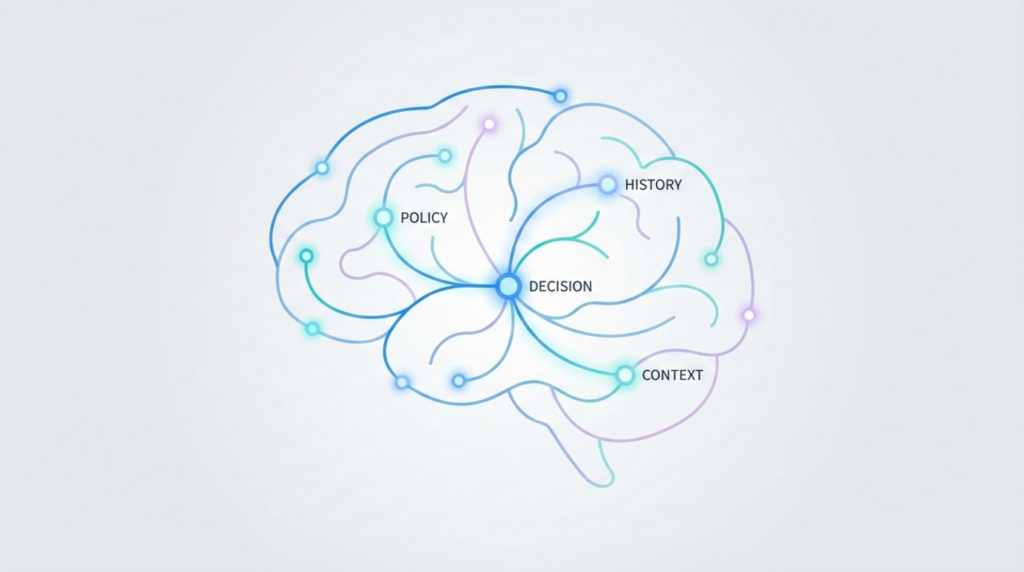
Context Graphs: AI’s Next Frontier and Why Your Data Must Be Ready
The Trillion-Dollar Shift Nobody’s Talking About
The enterprise software world is experiencing a quiet revolution that’s about to become impossible to ignore. We’re not just seeing companies adopt AI anymore—we’re watching the entire infrastructure of how businesses store and access knowledge shift fundamentally.
Until recently, the conversation centered on “systems of record”: databases that store what happened. Salesforce tracks transactions. SAP logs inventory changes. ServiceNow records tickets. But these systems capture only half the story. They answer “what happened?” with precision while remaining silent on the critical question that powers human judgment: “why was it allowed to happen?”
That’s where context graphs enter the picture. Unlike traditional data warehouses or knowledge graphs, context graphs represent something radically different. They’re living, searchable records of decision traces stitched across entities and time—capturing not just data, but the reasoning that drove business decisions. This distinction isn’t semantic. It’s the foundation of artificial intelligence that can actually work at scale in complex enterprises.
Understanding Context Graphs: The Missing Piece of Enterprise AI
Context graphs emerge at the intersection of three converging trends in enterprise software: agentic AI moving into production workflows, the maturation of retrieval-augmented generation (RAG) systems, and the hard-won realization that raw capability without structured knowledge leads to expensive hallucinations.
To understand what makes context graphs different, consider a real-world scenario: A customer service agent needs to approve a 40% discount on a high-value contract. Traditional systems present a choice: either approve (and violate pricing policy) or deny (and risk losing the customer). The agent—or an AI making this decision—reaches into organizational memory and recalls that this particular customer committed to a three-year partnership and serves as a reference account, meeting strategic partnership criteria that justify the exception.
In most enterprise systems today, that decision gets logged. The CRM records the discount. The ticketing system records the escalation. The financial system records the override. But the actual reasoning—the why—never enters any searchable system. It evaporates into emails, Slack conversations, and the memories of people who were involved.
A context graph captures that entire decision: the inputs considered, the policy evaluated, the exception criteria applied, and the approval rationale. When a similar situation arises months later, an AI agent doesn’t see an isolated data point (“a discount was approved”). It sees precedent: “VP Sarah Thompson approved a 40% discount for Customer X because they met our strategic partnership criteria, even though it violated standard pricing policy.”
That’s the unlock. Searchable precedent compounds over time, transforming how AI systems can reason about complex decisions.
The GraphRAG Evolution: Making AI Systems Actually Reliable
The evolution from basic RAG to context graphs reflects a hard lesson the industry learned in 2025: stuffing prompts with large amounts of context doesn’t make AI smarter. It makes it worse.
Early retrieval-augmented generation systems treated information retrieval like a simple vector search problem—find semantically similar text chunks and feed them to the language model. The assumption was logical: more information equals better answers. Reality disagreed.
Research from Databricks and Chroma revealed what they called “context rot”: beyond a certain size, larger contexts actually reduce model accuracy. When drowning in data, language models struggle to identify what matters. They make mistakes at higher rates. They lose coherence in reasoning.
This is why GraphRAG, developed by Microsoft’s AI Lab, represents a genuine advance. Rather than flooding models with undifferentiated text, GraphRAG structures information as a graph. Entities—customers, products, policies—become nodes. Relationships become edges. The system doesn’t retrieve all relevant information; it retrieves the minimum relevant information, with relationships intact, so the model can reason about connections that would be invisible to keyword or similarity search alone.
But even GraphRAG leaves something on the table. It optimizes for finding the right information, but context graphs go deeper. They’re designed to capture why decisions were made, not just what was decided.
Why 2026 is the Year of Unfulfilled Context Graph Promises
Industry analysts entered 2026 with cautious skepticism about context graphs. Sanjeev Mohan’s prediction was blunt: “Every company will claim to have a context graph, but the industry won’t be successful.”
Why? Because context is remarkably slippery to define operationally. Knowledge graphs have a clear definition—they model entities and relationships. Context graphs are harder to pin down. What constitutes relevant context? How do you capture decision reasoning at scale? How do you ensure that the captured context remains accurate as business rules evolve?
The gap between what context graphs promise and what they can practically deliver remains significant. Among AI adopters, only 27% had knowledge graphs in production in late 2025—barely an uptick from 26% a year and a half earlier. The challenge isn’t conceptual. It’s operational.
Building context graphs requires infrastructure that most enterprises lack:
- Instrumented workflows that capture decision data as processes execute
- Semantic clarity about what information matters and why
- Data governance ensuring that captured context stays accurate and auditable
- Access control preventing context leakage while enabling AI agents to learn from precedent
- Temporal awareness understanding how truth changes over time
Yet the potential remains enormous. Enterprises running agentic workflows are hitting a wall governance alone can’t solve. That wall isn’t missing data. It’s missing decision traces.
Agentic AI: The Real Catalyst for Context Graphs
The reason context graphs shifted from interesting research topic to urgent infrastructure need is the rapid move of AI agents into production workflows. Contract review. Quote-to-cash. Support resolution. Expense approval. These aren’t theoretical pilots anymore—they’re live systems handling real transactions.
When an agent proposes a contract approval or pricing exception, it needs more than the ability to retrieve relevant documents. It needs to understand organizational precedent. What exceptions have been approved before? Under what conditions? With what outcomes?
The power of context graphs in agentic systems comes from this feedback loop: Captured decision traces become searchable precedent. Every automated decision (or human-approved decision) adds another trace to the graph. Similar cases repeat. More of the decision path can be automated because the system now has a structured library of prior decisions and exceptions.
This is how AI systems move from 80% automation (good enough for pilots) to 99% automation (required for production). Not through raw capability improvements, but through organizational learning—the ability to remember, search, and apply previous decisions.
From Knowledge Graphs to Context Graphs: The Modeling Question
As context graph adoption accelerates, the industry is splitting into two camps around a fundamental question: How do you model reality?
One approach extends existing graph technology. Knowledge graphs + better ontologies + temporal reasoning = context graphs. This evolutionary path leverages established tools and methodologies.
The second approach treats context graphs as fundamentally different. Rather than optimizing how you represent facts, you optimize for capturing decision traces. You model workflows, decision points, approvals, and reasoning chains. Your graph becomes a system of record for decisions, not just objects.
This distinction matters because the two approaches lead to different architectures:
- Knowledge graph evolution produces richer semantic models but maintains the assumption that truth is reasonably static
- Context graph native systems prioritize the capture and evolution of decision logic and precedent
Neither approach has clearly won in production environments yet. What’s becoming clear is that this architectural choice—made in 2026—will compound for years.
The Data Readiness Imperative: Why Deeproot’s DRI Framework Matters
This is where a critical gap emerges between the vision of context graphs and their practical implementation. Building a context graph requires more than smart graph architecture. It requires foundational data readiness that most enterprises lack.
Deeproot.ai’s Data Readiness Index (DRI) provides a framework for understanding this gap. The DRI assesses organizational data across seven critical dimensions:
Quality: Completeness, duplication, timeliness, and accuracy of data. Poor data quality compounds when scaled through AI systems—garbage inputs produce garbage traces in your context graph.
Understandability: Metadata richness, data lineage, and clarity of definitions. If your team can’t explain what a data field means, your AI agents won’t be able to reason about it either.
Structural Integrity: Schema consistency, data formatting standards, and access latency. Context graphs query relationships constantly. Structural inconsistencies create brittle systems.
Value Metrics: Labeling completeness, feature importance, and uncertainty quantification. For decision traces to be useful, you need to understand which factors actually drove decisions—not just that decisions happened.
Fairness and Bias: Class balance, discrimination risk, and protected attribute handling. Decision traces amplify organizational biases. Without attention to fairness, your context graph becomes an automated perpetuation of past mistakes.
Governance: Data collection practices, privacy controls, and usage restrictions. Context graphs containing decision reasoning create significant regulatory and ethical obligations.
AI Fitness: Robustness, explainability, and alignment with model constraints. Can your data support the kind of reasoning agents need to perform?
Organizations scoring high across these dimensions don’t just have better data. They’re ready to build context graphs that actually work in production.
The Data Readiness Reality Check
Most enterprises discover the hard way that context graph ambitions exceed data readiness. A team gets excited about the idea of searchable decision traces and builds a prototype. The prototype shows promise. Then production hits.
They realize their data lacks the structure to reliably distinguish between “decision made because of policy” and “decision made despite policy.” Their metadata doesn’t capture the context that made the decision defensible. Their governance practices don’t ensure that decision traces remain accurate as business rules evolve. Their fairness analysis reveals that captured precedent encodes historical discrimination.
This isn’t a criticism of context graphs. It’s a recognition that context graphs are powerful precisely because they make organizational reasoning explicit and searchable. That power cuts both ways.
Building Data Readiness for Context Graphs
The path forward requires treating data readiness as a prerequisite, not an afterthought. Organizations serious about context graphs should:
Assess before investing: Use frameworks like Deeproot’s DRI to understand where your data stands across the seven dimensions. The results often shock leadership—data that felt sufficient for traditional analytics proves insufficient for agentic reasoning.
Prioritize structural integrity first: Before capturing decision traces, ensure that your foundational data—customer records, product catalogs, transaction histories—is structured consistently. GraphRAG and context graphs will only work reliably if they build on solid foundations.
Implement workflow instrumentation: Design your business processes to capture decision context. What policy was evaluated? What data informed the decision? What exceptions were applied? Make capturing this information as natural as executing the transaction.
Build governance into the model: Don’t bolt governance on afterward. Design context graphs with privacy controls, audit trails, and fairness checks built in from the start. When decision reasoning is transparent and searchable, governance becomes architectural.
Start with high-impact, low-complexity use cases: Don’t attempt to build enterprise-wide context graphs immediately. Find a process where context matters (high-stakes decisions with repeatable patterns) and data readiness is already high. Use that success to inform larger rollouts.
The Competitive Inflection Point
2026 marks an inflection point. Companies with strong data readiness, organizations that understand their data deeply, govern it carefully, and structure it precisely—can begin building context graphs that compound organizational knowledge. They become smarter and faster as more decisions get made and captured.
Companies that skip data readiness hit a different trajectory. Their context graphs capture garbage. Their decision traces encode biases. Their AI agents inherit flawed precedent. What was supposed to accelerate the business becomes a source of risk.
This isn’t a technology problem anymore. It’s a data maturity problem. And data maturity takes time.
Conclusion: The Foundation Before the Framework
Context graphs represent a genuine step forward in how AI can reason within enterprises. The vision is compelling: AI agents with access to searchable organizational memory, continuously learning from past decisions and improving at navigation complex judgment calls.
But that vision has a prerequisite. Your data must be ready. Your datasets must be structured, governed, auditable, and fair. Your business processes must be instrumented to capture reasoning, not just outcomes.
This is where Deeproot’s AI Data Readiness Index becomes indispensable. Before investing in context graph infrastructure—before building sophisticated knowledge representations and decision capture systems—understand where your data stands. Assess it honestly across the seven dimensions that matter: quality, understandability, structural integrity, value metrics, fairness, governance, and AI fitness.
The organizations that win in the context graph era won’t be those with the fanciest graph databases. They’ll be the ones that treated data readiness as foundational. The ones that structured, governed, and curated their datasets with intention. The ones that understood that for the right context to exist, the dataset must be ready.
Your AI is rooted in your data. Make sure that soil is fertile.