

The Executive Reality Check: Why 89% of C-Suite Leaders Are Accelerating Agentic AI Transformation
The disconnect between AI ambition and execution is costing enterprises millions. Here’s how forward-thinking leaders are bridging the gap to deliver measurable results.
The boardroom conversations have shifted dramatically. Gone are the days when artificial intelligence was a “future consideration” for quarterly planning sessions. Today’s C-suite reality is stark: 89% of executives are advancing generative AI initiatives in 2025, yet a troubling gap persists between leadership vision and organizational execution.[1]
Recent research from Thomson Reuters reveals a telling paradox: while 82% of C-suite leaders claim their organizations are using AI solutions in workflows, only 34% have actually equipped employees with AI tools. This disconnect isn’t just a statistical curiosity, it represents billions in unrealized value and competitive disadvantage accumulating daily.[2]
The True Cost of AI Inaction
The financial implications are staggering. Organizations successfully implementing AI report a $3.70 return for every dollar invested, with leading enterprises achieving productivity gains exceeding 40% through intelligent automation. Meanwhile, companies trapped in pilot purgatory face mounting pressure as competitors leverage AI for strategic advantage.[3][4]
Consider the broader market dynamics: global AI spending has reached $644 billion in 2025, yet an astonishing 97% of enterprises still struggle to demonstrate business value from their early AI efforts. This dramatic gulf between AI investment and measurable outcomes has created what industry analysts call the “AI implementation crisis.”[5]
The Leadership Paradox
The disconnect extends beyond mere technology adoption. 80% of C-suite executives report providing AI training several times annually, yet research shows most professionals receive no training whatsoever. This leadership blind spot reveals a fundamental misunderstanding of how AI transformation actually occurs within an organization.[2]
Successful AI transformation isn’t driven by executive mandates or isolated pilot projects. It requires systematic change management, strategic use case identification, and enterprise-grade implementation that bridges the gap between C-suite vision and operational reality.
The Agentic AI Revolution: Beyond Traditional Automation
Forward-thinking enterprises are moving beyond basic AI tools toward agentic AI systems, autonomous agents capable of complex reasoning, decision-making, and action-taking without constant human intervention. This represents a fundamental shift from generative AI’s content creation focus to true operational transformation.[7]
Leading organizations deploying agentic AI report remarkable outcomes:
- 78% improvement in operational efficiency
- 56% faster response times across customer-facing processes
- 43% of staff time freed for strategic, high-value activities
- Enhanced decision-making through advanced analytics integration
The competitive implications are profound. Companies implementing agentic AI aren’t just automating existing processes, they’re fundamentally redesigning how work gets done, creating sustainable advantages that compound over time.[7]
The Multi-Modal AI Advantage
The next wave of AI transformation integrates multiple data types and interaction modes. Organizations leveraging multimodal AI for marketing and operations are seeing exponential returns, with the market projected to reach $15.89 billion by 2032 at a 35% compound annual growth rate.
This technology enables unprecedented personalization, predictive analytics, and decision support across previously disconnected business functions. Enterprises that master multimodal AI integration position themselves to capture disproportionate value as the technology matures.[8]
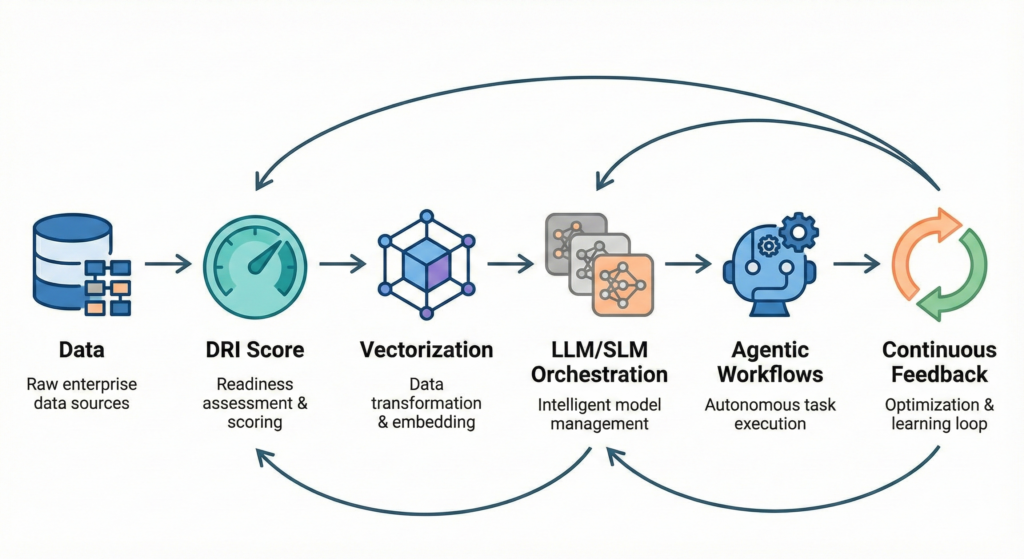
The Enterprise AI Implementation Framework
Successful AI transformation follows a predictable pattern. The most effective implementations share three critical characteristics:
1. Strategic Alignment First
Top-performing organizations begin with comprehensive use case discovery that directly maps AI capabilities to specific business outcomes. This isn’t about deploying AI broadly, it’s about identifying high-impact applications where AI can deliver measurable results quickly.[9]
2. Data Foundation Excellence
Companies achieving superior AI ROI invest heavily in data readiness before deploying advanced AI systems. This includes data quality optimization, governance frameworks, and architecture designed for AI workloads from the ground up.[5]
3. Continuous Optimization
Leading enterprises treat AI deployment as an iterative process. They implement robust feedback loops, performance monitoring, and continuous model refinement that enables AI systems to improve over time.[7]
Measuring What Matters: The ROI Framework
The most sophisticated enterprises have moved beyond vanity metrics to focus on business-critical measurements:
- Operational Impact: Direct measurement of efficiency gains, cost reductions, and productivity improvements. Key metrics include processing time reduction, error rate improvements, and human-AI collaboration effectiveness.[7]
- Strategic Value Creation: Assessment of new capabilities, market opportunities, and competitive advantages enabled by AI. This includes new revenue generation, improved customer experiences, and accelerated innovation cycles.[9]
- Risk Mitigation: Quantification of risks avoided, compliance improvements, and enhanced decision quality. Forward-thinking leaders recognize that AI’s value often lies in preventing negative outcomes, not just driving positive results.[10]
The Executive Action Plan
Based on successful AI transformations across industries, several actionable strategies emerge for C-suite leaders:
- Establish AI Centers of Excellence: Create dedicated teams responsible for enterprise-wide AI strategy, implementation, and governance to bridge the gap between technical capabilities and business requirements.[11]
- Invest in Change Management: Deploy comprehensive programs that address cultural resistance, skill development, and workflow redesign to ensure successful adoption.[12]
- Prioritize Data Infrastructure: Ensure robust data foundations before deploying advanced AI. Poor data quality is the leading cause of AI project failure.[5]
- Focus on High-Impact Use Cases: Resist broad implementation. Instead, identify specific applications where AI can deliver clear, measurable business value quickly.[9]
The Path Forward: Turning Vision into Value
The AI transformation imperative is clear, but execution remains the critical differentiator. Organizations that successfully bridge the gap between C-suite vision and operational reality will capture disproportionate value in the new AI-driven economy.[13]
The window for first-mover advantage is narrowing rapidly. As AI capabilities mature, competitive advantage will shift to organizations with superior implementation capabilities, data assets, and change management expertise.[14]
Ready to transform your AI vision into measurable business outcomes?
The executives leading successful AI transformations aren’t just investing in technology, they’re partnering with proven implementation specialists who understand the complexities of enterprise AI adoption.
At Innoflexion, our DeepRoot platform has powered AI transformation across healthcare, finance, education, and technology sectors, helping enterprises move past pilot purgatory and into scalable, outcomes-driven deployment.
Our comprehensive approach addresses every facet of enterprise AI execution:
- Strategic AI Readiness & Use-Case Blueprinting: We begin by assessing your data through DeepRoot’s readiness framework, mapping real-world data conditions to high-impact AI opportunities so every initiative starts with clarity and feasibility.
- Enterprise Data Readiness Engine & Orchestration Layer: DeepRoot prepares and enriches data, then connects it to a secure LLM–SLM orchestration layer that enables consistent, production-grade AI deployment across functions and systems.
- Agentic Workflows & Domain-Specific Task Agents: DeepRoot activates agentic capabilities with autonomous task agents that can reason, plan, and execute multi-step workflows—built with enterprise governance, auditability, and integration at the core.
- Continuous Intelligence & Lifecycle Optimization: With built-in monitoring, drift detection, quality scoring, and controlled refinement, DeepRoot ensures every AI system improves over time, strengthening reliability and long-term business impact.
Don’t let the AI implementation gap cost your organization millions in unrealized value. Discover how Innoflexion’s Gen AI services can transform your enterprise AI vision into a competitive advantage.
The leaders succeeding in AI transformation aren’t just visionaries, they’re strategic executors with the right partners. Join them.