
Generative AI Strategy for Enterprises: Bubble Risk or Real Business Opportunity?
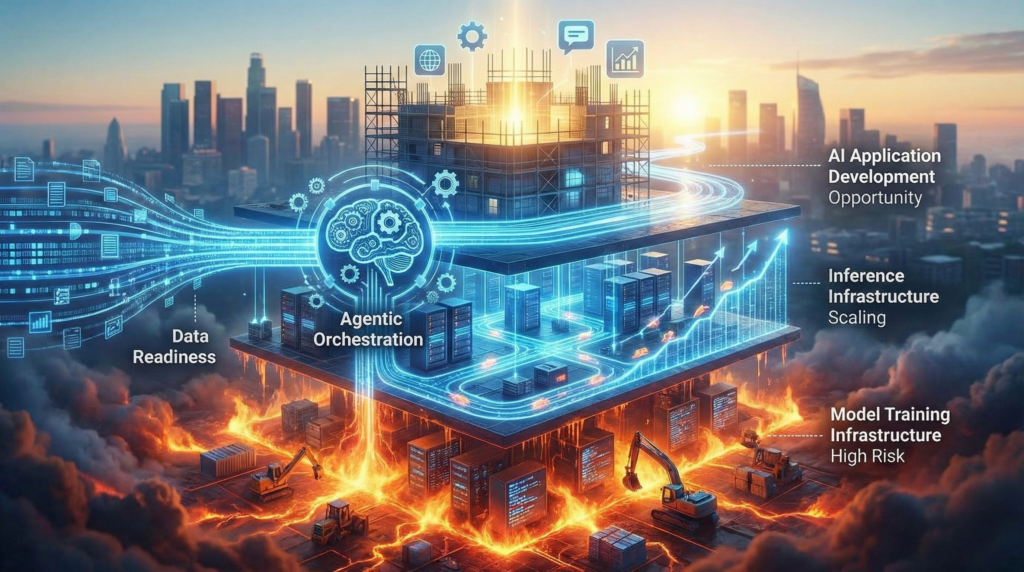
The rapid acceleration of Generative AI has triggered both enthusiasm and caution. OpenAI’s multi-trillion-dollar infrastructure roadmap and Nvidia’s market cap surge have led many to ask whether AI investments are justified or speculative. But AI is not a single market. Each layer of the Generative AI stack presents different levels of maturity, opportunity, and risk.
Understanding where to invest, and where to proceed carefully, is essential for CIOs, CTOs, and digital transformation leaders. This article breaks down the Generative AI landscape into three key layers: the application layer, inference infrastructure, and model training infrastructure. It also highlights why data readiness and agentic AI orchestration are becoming critical for delivering real business value.
AI Application Development: The Most Underinvested Layer
Despite the visibility of AI models and infrastructure, the real value is created through applications that solve domain-specific problems. Today, the Generative AI application layer remains significantly underinvested relative to its long-term potential.
Many organizations are still in the early stages of AI application development, experimenting with chatbots or copilots. However, high-performing enterprises are building intelligent tools powered by Large Language Models (LLMs) to improve decision-making, automate workflows, and personalize user experiences.
Key reasons for the gap:
- Venture capital often favors infrastructure because it is easier to benchmark and scale.
- There is a perception that better LLMs from frontier companies will outcompete specialized applications.
- Many executives are still unsure how to evaluate or deploy AI applications effectively.
This underinvestment represents a major opportunity. Organizations that align AI capabilities with proprietary data and domain-specific knowledge will build defensible applications that outperform general-purpose tools. The next wave of value in Generative AI will come from verticalized solutions tailored to enterprise use cases.
Inference Infrastructure: Scaling to Meet Enterprise Demand
Inference infrastructure powers the execution of AI models in real time. As Generative AI moves from experimentation to production, enterprises face a growing need for high-throughput, cost-efficient inference infrastructure.
Even with relatively low market penetration, demand for compute resources is outpacing supply. This is particularly evident in use cases such as code generation, intelligent assistants, and multi-agent workflows that require sustained token generation and rapid response times.
Observations from the field:
- Many AI teams are constrained by GPU availability and rising inference costs.
- Infrastructure providers are racing to meet enterprise demand, but bottlenecks persist.
- The shift to agentic workflows will further increase inference requirements.
While there is always a risk of overbuilding, excess capacity is likely to be absorbed by application growth. Investing in scalable, efficient inference infrastructure is essential to enable reliable, high-performance GenAI deployment across the enterprise.
Model Training Infrastructure: High Investment, Higher Risk
Building foundation models from scratch remains the most capital-intensive part of the AI stack. It also carries the highest risk, especially for companies without a clear distribution advantage or differentiated data.
Several trends are making large-scale model training less attractive for general enterprises:
- Open-source and open-weight models are narrowing the performance gap.
- Hardware and algorithmic advances are reducing the cost of training powerful models.
- Brand moats (like ChatGPT) and distribution channels (like Gemini through Google) are harder to replicate than technical capability alone.
Most enterprises are better served by adopting existing LLMs and focusing their resources on fine-tuning, retrieval-augmented generation (RAG), and integration strategies rather than building models from the ground up.
The Foundation of AI Success: Data Readiness
No Generative AI strategy can succeed without high-quality, contextualized, and accessible data. Many organizations underestimate the importance of data readiness for AI, leading to project delays, underwhelming results, or compliance risks.
Core components of data readiness:
- Data quality and structure: Cleaning, organizing, and contextualizing internal data assets.
- Accessibility and integration: Connecting systems across silos while maintaining governance.
- Scoring and prioritization: Identifying which data sets and workflows are most AI-ready.
Establishing a formal data readiness framework allows teams to assess and prioritize opportunities before investing in model integration. This avoids wasted time on use cases that are technically infeasible or strategically irrelevant.
Enabling Real AI Workflows: The Role of Agentic Orchestration
As AI use cases mature, enterprises are shifting from single-turn interactions to agentic AI workflows, systems where AI agents can plan, reason, and act across multiple steps with minimal human intervention.
Agentic orchestration coordinates these workflows across structured and unstructured data, tools, APIs, and LLMs. It enables enterprises to automate complex tasks such as report generation, compliance checks, customer onboarding, and research synthesis.
Benefits of agentic orchestration:
- Transforms AI from a support function into a core automation engine.
- Increases productivity by reducing human dependency in decision cycles.
- Creates modular, reusable components across departments and teams.
This is where enterprise Generative AI moves beyond pilots and prototypes and becomes a system of intelligence.
DeepRoot Ai: Operationalizing Data and Orchestration for Generative AI
To successfully implement a Generative AI strategy, organizations must connect data readiness with orchestration. This is where DeepRoot AI provides strategic value.
DeepRoot AI is an enterprise AI platform that enables organizations to prepare, assess, and activate their data for GenAI adoption. It combines a structured Data Readiness Index (DRI) with agentic AI orchestration capabilities to deploy intelligent workflows across the business.
DeepRoot AI helps enterprises:
- Measure and improve the readiness of internal data assets.
- Build agentic workflows that execute real business processes.
- Integrate securely with preferred LLMs (OpenAI, Claude, Gemini, or open models).
- Move from isolated experiments to scalable GenAI applications.
Whether you’re designing an AI-powered knowledge assistant or enabling RAG-based document search, deeproot.ai helps convert vision into impact with speed, security, and clarity. Explore how your enterprise can adopt Generative AI with confidence at www.deeproot.ai
Conclusion
Is Generative AI a bubble or a breakout? The answer depends on where you look. Model training may face market correction. Infrastructure is racing to keep up. But the application layer, where AI solves real business problems, remains underexplored and undervalued.
The future of enterprise AI will be defined not by who builds the biggest model, but by who builds the smartest workflows with the most usable data. A well-aligned Generative AI strategy, supported by data readiness and agentic orchestration, will unlock compounding value for years to come.
If you’re ready to align your data, workflows, and AI goals, visit deeproot.ai to begin your journey.