
Why 95% of AI Pilots Will Fail in 2026: The 5 Signs Your Data Isn’t Ready
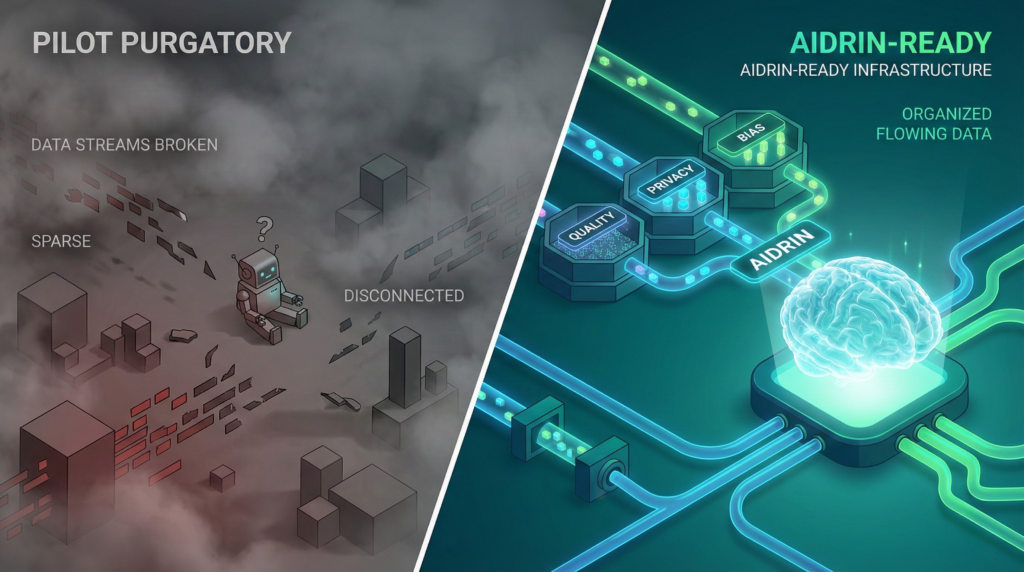
The “Honeymoon Phase” of Generative AI is officially over. As we move into late 2025 and 2026, the market has shifted from experimentation to execution. Yet, a brutal reality is emerging in boardrooms across the globe: Pilot Purgatory.
Gartner and MIT research indicates that nearly 95% of enterprise GenAI pilots fail to scale into production. They work flawlessly in a sandbox but collapse when connected to live enterprise data pipelines. They hallucinate, they leak privacy, or they simply fail to retrieve relevant context.
The failure isn’t in your model choice (GPT-4o, Llama 3, or Claude). The failure is in your Data Readiness.
At DeepRoot.ai, we don’t guess about readiness. We engineer it inspired from the AIDRIN (AI Data Readiness INspector) framework. Our framework isn’t just a checklist; it is a scientifically rigorous, multi-dimensional protocol that quantifies exactly why your data will break an AI model before you even write the first line of code.
Here are the 5 technical signs your enterprise is walking into a failed pilot—and how the AIDRIN protocol orchestrates the solution.
Sign 1: The “Sparsity Trap” (Quality & Completeness)
Most enterprises assume their data is “rich.” In reality, it is often “sparse.” In a traditional analytics context, a missing field in a CRM record is a minor annoyance. In a Vector RAG (Retrieval-Augmented Generation) context, it is catastrophic.
The Technical Failure:
If your embeddings are generated from sparse data (e.g., customer profiles with 40% empty fields), your Vector Search will fail to find “nearest neighbors” effectively. The AI doesn’t see “missing data”; it sees “zero relationships,” leading to high-confidence hallucinations.
The Solution:
DeepRoot’s engine performs deep Sparsity Analysis. We don’t just count nulls; we calculate the semantic impact of missing data on vector distance.
The Fix: Automated imputation pipelines that flag “Low-Density” records and exclude them from the context window until they meet the Quality Threshold.
Sign 2: The “Governance Gap” (Privacy & Governance)
You are likely relying on “Post-Generation” filtering—hoping the LLM won’t repeat the PII (Personally Identifiable Information) it reads. This is a security nightmare waiting to happen.
The Technical Failure:
Standard anonymization (masking names) is insufficient for high-dimensional AI. Attacks like “Linkage Attacks” can re-identify individuals by correlating supposedly anonymous data points.
The Solution:
DeepRoot implements advanced privacy metrics directly from the AIDRIN framework, specifically k-Anonymity and l-Diversity.
- k-Anonymity: Ensures that any record is indistinguishable from at least k-1other records.
- l-Diversity: Ensures that sensitive attributes within those groups possess enough diversity to prevent attribute disclosure.
The Fix: Our Orchestration Layer enforces these mathematical privacy guarantees before data ever touches the model context.
Sign 3: The “Feature Noise” Dilemma (Impact on AI)
You are feeding everything to the AI. “More context is better,” right? Wrong. In the era of massive context windows (128k+ tokens), Noise is the enemy of Reasoning.
The Technical Failure:
This is known as the “Lost in the Middle” phenomenon. When you flood an LLM with low-value data (irrelevant email footers, legal disclaimers, duplicate logs), the model’s attention mechanism degrades. It fails to attend to the critical signal buried in the noise.
The Solution:
We utilize AIDRIN’s Feature Relevance & Correlation metrics. DeepRoot scans your unstructured data to identify “High-Entropy” signals (unique, information-dense content) versus “Low-Entropy” noise.
The Fix: Intelligent Chunking that automatically strips low-value segments, ensuring your token budget is spent only on high-impact data.
Sign 4: The “Bias Blindspot” (Fairness & Bias)
Your pilot works great for your US-based sales team but fails for your APAC operations. Why? Because your training or retrieval data is statistically skewed.
The Technical Failure:
Class Imbalance. If 90% of your successful “closed-won” deal examples in the vector database are from one region or product line, the Agent will statistically favor that pattern, ignoring valid strategies for other regions.
The Solution:
DeepRoot applies Bias Detection Algorithms to measure representational skew. We generate a “Fairness Heatmap” of your data lake.
The Fix: Synthetic Data Augmentation (SDA). DeepRoot can orchestrate the generation of synthetic examples to balance underrepresented classes, ensuring your AI Agent behaves consistently across all business units.
Sign 5: The “Lineage Black Hole” (Understandability & Usability)
The AI gives an answer, but you can’t trace it back to the source. The C-Suite asks, “Which document said we can offer a 5% discount?” and the AI says, “I don’t know.”
The Technical Failure:
Lack of Metadata Lineage. Vectors are often stored as “orphan” mathematical representations without their parent metadata (Author, Version, Date, Clearance Level).
The Solution:
DeepRoot enforces FAIR Principles (Findable, Accessible, Interoperable, Reusable) within the vectorization process. Every chunk of data is tagged with immutable lineage metadata.
The Fix: When DeepRoot orchestrates a response, it provides a click-through citation to the exact version-controlled source document, bridging the gap between “AI Magic” and “Enterprise Auditability.”
The Missing Metric: What is Your “DRI score”?
As we navigate 2026, the divide between successful AI adoption and “Pilot Purgatory” is no longer about who has the best model. It is about who has the best visibility.
Right now, your data is making decisions for you. It’s deciding whether your AI hallucinates or delivers, whether it protects privacy or leaks it. The problem is, most enterprises are operating without a dashboard. They are launching sophisticated engines on fuel they haven’t tested.
This is where the conversation shifts.
We didn’t build DeepRoot just to fix data; we built it to quantify the invisible. The AIDRIN Framework doesn’t just clean up the mess—it assigns your enterprise a Data Readiness Index (DRI).
Think of your DRI as a credit score for your AI ambitions. A score of 85 means you are ready to scale agents autonomously. A score of 45 means your “governance gap” is a ticking time bomb.
Do you know your Enterprise DRI score?
You cannot engineer what you cannot measure. Before you commit to the next phase of your roadmap, you owe it to your strategy to see what the algorithms see. Stop guessing. Start measuring.
Explore the Deeproot framework and discover how “Data Readiness” changes the way you look at AI.
Uncover Your Data Readiness Score: click here