
Why Your AI Strategy Needs a Data Readiness Index (DRI)Data Readiness Index
Why Are We Still Cleaning Data?
It is 2026. Generative AI has been “mainstream” for three years. Yet, a staggering statistic dominates boardroom discussions: 95% of enterprise AI pilots launched in Q4 2025 are still stuck in “Pilot Purgatory.”
They work beautifully in a sandbox with curated CSVs. But the moment you point that LLM at your live enterprise data warehouse? Hallucinations, compliance breaches, and silence.
For CTOs and CDOs, the bottleneck isn’t the model, it’s not about choosing between Gemini 3.0 or GPT-5. The bottleneck is, and always has been, Data Readiness.
The industry has shifted. We are moving away from the era of “move fast and break things” to the era of “audit, score, and scale.” This is the story of how we used to guess if our data was ready, and how the DeepRoot.ai Data Readiness Index (DRI), inspired by the rigorous DRI framework, is automating the most painful part of the AI stack.
The “Old Way”: Manual Qualification (A Data Scientist’s Nightmare)
Let’s rewind to how we “qualified” data for AI pilots in 2024 and 2025.
You hired a team of expensive Data Scientists. You gave them access to your Snowflake or Databricks instance. Then, for the next eight weeks, they didn’t build models. They did Manual Data Qualification.
It looked like this:
- Subjective Sampling: A data engineer would eyeball 100 rows of customer support logs. “Looks clean,” they’d say.
- The “Data Nutrition Label” Struggle: Teams tried to manually create labels for datasets—documenting lineage, bias, and completeness in static PDFs or Wikis.
- Governance Bottlenecks: Every new dataset required a manual sign-off from Legal, causing weeks of delay.
- Hidden Bias: You wouldn’t find out your hiring dataset was biased against specific demographics until after the model was deployed and the PR disaster hit.
The Result?
Subjective “readiness”. A dataset deemed “ready” by Team A was rejected by Team B. The process was slow, unscalable, and fundamentally broken for the velocity of GenAI.
The New Standard: The DeepRoot Framework
To solve this, DeepRoot adopted a structured approach inspired by AIDRIN Framework. It’s not just a buzzword; it is a rigorous, multi-pillar framework designed to quantify the nebulous concept of “quality.” It moves us from feeling like data is ready to knowing it is.
The framework evaluates data across six critical dimensions:
- Quality: Completeness, accuracy, and consistency.
- Impact on AI: Feature relevance and correlation (will this actually help the model?).
- Understandability: Is the metadata clear? Can an agent figure out what this column means?
- Fairness & Bias: Statistical detection of representation gaps.
- Structure: Schema validity and organization.
- Governance: Privacy risks (PII/PHI) and lineage.
DeepRoot.ai took this academic framework and operationalized it into an automated enterprise engine.
DeepRoot DRI: Automating the “Go/No-Go” Decision
The DeepRoot Data Readiness Index (DRI) is your automated auditor. Instead of humans manually sampling rows, the DeepRoot platform connects to your data sources (SQL, NoSQL, APIs) via metadata-only ingestion (keeping your data secure and in place).
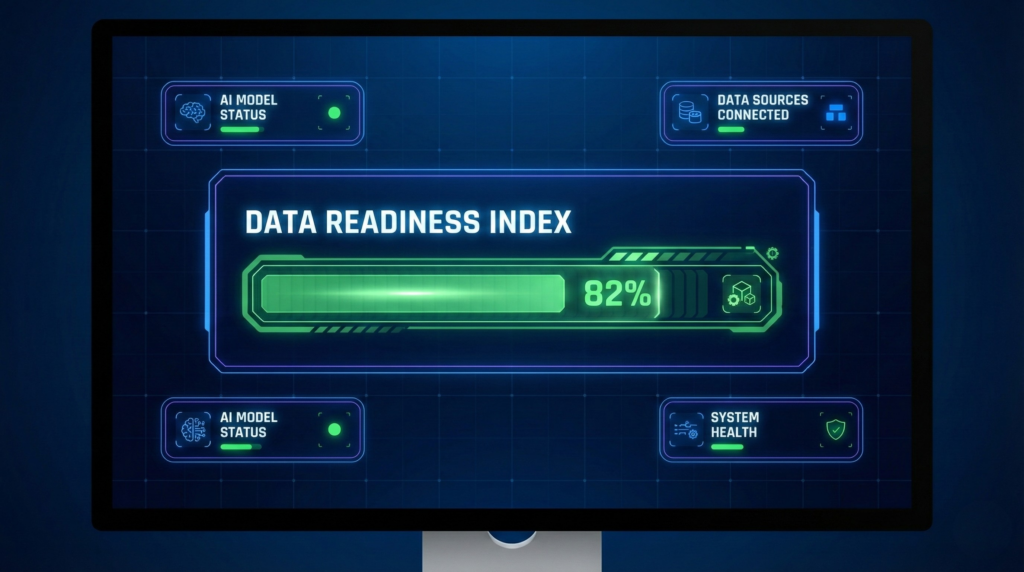
It runs continuous automated assessments to generate a DRI Score (0-100) for every dataset, pipeline, and domain in your enterprise.
How the Scoring Works
Imagine a credit score, but for your data’s ability to feed an LLM.
- DRI < 35 (Red): Do Not Use. The data is too sparse, unstructured, or riddled with PII to be safe for GenAI.
- DRI 35-70 (Yellow): Restricted Use. Usable for internal analytics but requires “Human in the Loop” guardrails. Likely missing semantic metadata.
- DRI > 70 (Green): “AI-Ready.” High-quality, governed, unbiased, and semantically rich. Ready for autonomous agents.
The “Killer Feature” for Developers: Chat with Your Data via D.A.V.E.
Developers no longer need to sift through static logs or guess why a pipeline failed. The DeepRoot platform allows you to connect your own agents directly to the DRI engine.
Instead of just receiving a passive report, you can engage D.A.V.E. (DeepRoot AI Virtual Expert) to actively investigate your datasets. You can literally chat with your data to uncover abnormalities in real-time.
The Workflow: You ask, “D.A.V.E., why is the ‘Customer_Sentiment’ dataset flagged as Red?”
The Answer: D.A.V.E. instantly diagnoses the root cause: “I detected a 40% spike in null values in the ‘Feedback’ column and high PII risks in the unstructured text fields.”
It transforms “debugging” into a conversation, allowing you to identify quality gaps and fix them before your agent ever hits production.
Technical Deep Dive: From Chaos to Context
For the techies reading this, here is how DeepRoot transforms the manual workflow into an automated one:
Feature | The Manual Way | The DeepRoot DRI Way |
Bias Detection | Post-training audit (too late) | Pre-ingestion scanning: Statistical analysis detects class imbalances before the model sees data. |
PII Redaction | Regex scripts written by interns | Context-aware NER: Automatically flags and scores privacy risks in unstructured text. |
Semantic Density | “The column names look descriptive” | Vector Profiling: Analyzes the actual content to see if it semantically matches the intended use case. |
Updates | One-time check at project start | Continuous Monitoring: DRI scores update in real-time as data flows change. |
The Strategic Value for CTOs and CXOs
If you are a leader, you aren’t looking for better logs; you are looking for velocity.
- Kill Bad Projects Fast (Fail Cheap): DeepRoot DRI allows you to assess feasibility in minutes, not months. If the Marketing team wants a “GenAI Copywriter” but their data has a Red DRI of 35, you can kill the project on Day 1 before spending $50k on compute.
- Audit-Ready by Default: With regulations tightening in 2026, “we thought the data was clean” is not a legal defense. DeepRoot provides a timestamped, immutable history of DRI scores for every model version. You can prove exactly what state the data was in when a decision was made.
- Bridge the Trust Gap: The biggest barrier to GenAI adoption isn’t technology; it’s trust. When you can show stakeholders a “Green” DRI score, you provide the mathematical confidence needed to move from a pilot to a production rollout.
Conclusion: Don’t Let Bad Data Ground Your Pilot
The era of manual data qualification is over. It is too slow, too risky, and too expensive. To win in the AI economy of 2026, you need to treat Data Readiness not as a chore, but as a metric, a KPI that is tracked, optimized, and automated.
DeepRoot.ai doesn’t just tell you your data is messy; it gives you the map to fix it. It turns the “black box” of data quality into a transparent, actionable score.
Are you ready to see your score?
Don’t launch another pilot in the dark. Connect your data to DeepRoot today and get your preliminary Data Readiness Index.
See DeepRoot in Action: Schedule a Demo