
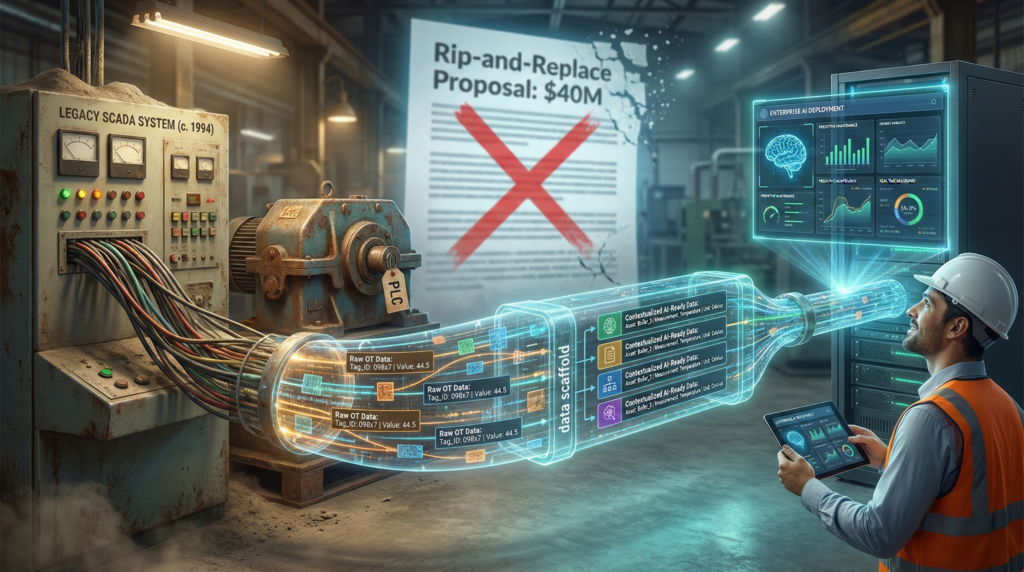
How to Make Legacy Systems AI-Ready (Without the $40M Rip-and-Replace)
The mandate from the boardroom is clear: implement artificial intelligence to optimize operations, predict mechanical failures, and drive plant efficiency. But down on the factory floor, operations leaders are staring at a completely different reality. They are managing 30-year-old SCADA systems, aging PLCs, and legacy historians that predate the modern internet.
The immediate assumption from IT and leadership is often fatal to innovation: “We have to rip and replace all of this legacy hardware before we can even think about AI.”
This misconception leads to paralyzing $40 million modernization proposals, years of projected operational downtime, and massive organizational resistance from the plant floor. But the hard truth reshaping the industrial sector is this: your legacy systems aren’t the problem—your data governance is. Those 30-year-old systems still do exactly what they were engineered to do: control physical processes safely and reliably. The roadblock to AI isn’t the hardware; it’s the metadata crisis hiding inside your data architecture. By shifting the focus from system replacement to data readiness and establishing the right context, industrial organizations can bridge the IT/OT divide and deploy enterprise AI in a fraction of the time and cost.
Here is the definitive playbook for making legacy industrial data AI-ready.
What is Data Readiness in Industrial AI?
Data readiness for AI in industrial and manufacturing environments is the process of transforming raw, siloed Operational Technology (OT) data into a standardized, governed, and contextualized format that Information Technology (IT) applications and Large Language Models (LLMs) can natively interpret. It involves establishing clear data lineage, uniform naming conventions, and robust metadata management without altering or replacing the underlying legacy control systems.
Achieving data readiness means moving away from point-to-point integrations. Instead, forward-thinking organizations are building a modern data scaffold around their existing infrastructure. In software engineering, this is known as the “strangler pattern”—extracting the value and data of the legacy system into a new, modern layer without touching the core logic that keeps the facility running.
To achieve true data readiness, organizations must focus on a single, critical metric: Understandability.
The Metadata Crisis: The Silent Killer of AI Projects
If you feed raw legacy data into a predictive machine learning algorithm or an enterprise LLM, it will fail. Currently, in the average industrial facility, up to 73% of legacy sensor data lacks basic contextual documentation.
Industrial sensor networks generate continuous, massive streams of numeric measurements. However, a raw output of 44.5 sent from an edge device to a cloud data lake is functionally meaningless. Without knowing if 44.5 represents degrees Celsius, PSI, or a vibration frequency—and without knowing which specific boiler or turbine it belongs to—an AI model cannot generate actionable insights.
When organizations attempt to implement AI without addressing this underlying metadata crisis, their data science teams end up spending 70% to 80% of their time acting as data janitors. They manually verify data, interview plant engineers to understand legacy naming conventions, and try to reverse-engineer meaning from decades of inconsistent, undocumented tagging.
The Missing Link: Why the “Right Context” is Non-Negotiable
AI models, particularly those used for autonomous anomaly detection or predictive maintenance, rely heavily on relationships between entities. They do not just need data; they need the right context to function.
Establishing the right context means permanently bridging the IT/OT gap so that every sensor reading carries complete operational and business meaning. When you wrap legacy data in rich context, you transform a raw, isolated data point into a high-value, AI-ready asset.
The Power of Contextualization in Practice
Consider a standard legacy temperature sensor.
- Raw OT Data (No Context): Tag_ID: 098×7 | Value: 44.5
- Contextualized AI-Ready Data: Asset: Boiler_3 | Component: Water_Intake_Valve | Measurement: Temperature | Unit: Celsius | Status: Active | Max_Threshold: 50.0 | Value: 44.5
When an AI system receives the contextualized version, it doesn’t just see a floating number. It understands the equipment hierarchy, the physical unit of measure, the operational boundaries, and the system status. This eliminates the need for the model to “guess” or learn the operational meaning from scratch, drastically reducing model training time and preventing costly AI hallucinations.
The Legacy-to-AI Playbook: A 7-Step Governance Framework
You do not need to pause production to achieve data readiness. By implementing a strict data governance framework, asset-intensive organizations have routinely seen their data usability and trust metrics jump from 55% to 89% in under six months.
Here is the 7-step framework to build your AI-ready data scaffold:
1. Diagnose the Metadata Gap
Begin with a comprehensive audit of your existing SCADA tags and historians. Acknowledge the reality of your current state. Quantify exactly how much of your legacy data lacks contextual documentation (units, thresholds, asset mapping). You cannot fix what you have not measured.
2. Implement the Middleware Scaffold
Stop trying to force modern AI tools to read legacy, proprietary protocols directly. Implement an edge gateway or middleware layer to extract data safely. Using protocols like MQTT or OPC UA, publish this data into a Unified Namespace. This acts as a centralized data hub, decoupling the legacy SCADA from the AI consumption layer and preventing any risk to operational uptime.
3. Standardize the Equipment Hierarchy
Before data hits the AI model, it must be mapped to a standardized equipment hierarchy. Implement a rigid framework across all facilities (e.g., Enterprise $\rightarrow$ Site $\rightarrow$ Area $\rightarrow$ Line $\rightarrow$ Cell $\rightarrow$ Asset). This standardization ensures that an AI model evaluating “Pump Efficiency” at a plant in Texas is using the exact same contextual parameters as a plant in Germany.
4. Enforce Metadata Tagging Templates
Address the documentation gap by enforcing strict semantic tagging. Every data stream must pass through a governance filter that appends critical metadata, including:
- Sensor ID and plain-text description.
- Unit of Measure (UoM).
- Operational State (Active, Maintenance, Calibration).
- Engineering Thresholds and Tolerances.
5. Establish Data Provenance and Lineage
Trust is the currency of AI adoption on the plant floor. If operators do not trust the AI’s recommendations, they will override them. Establish clear data provenance—a traceable, auditable lineage from the exact 30-year-old PLC on the floor to the cloud dashboard. If an anomaly is flagged, the system must be able to cite exactly which sensor generated the fault.
6. Deploy Agentic Quality Remediation
Data governance cannot be a manual, once-a-year audit. Deploy automated, agentic checks within your data pipeline to monitor data health continuously. If a sensor suddenly starts sending string data instead of integers, or if latency spikes beyond acceptable limits, the governance layer should automatically flag and quarantine the data before it corrupts your predictive models.
7. Feed the AI-Ready Layer
Once your legacy data is standardized, contextualized, and governed, it is officially AI-ready. You can now securely feed this highly structured data into advanced predictive maintenance algorithms, digital twins, or enterprise LLMs to start driving immediate ROI.
The Bottom Line: Govern, Don’t Replace
The narrative that industrial AI requires a total infrastructure teardown is a myth that costs enterprises tens of millions of dollars and years of lost innovation. Your 30-year-old SCADA systems are not the enemy. The lack of standard metadata, unified namespaces, and IT/OT context is.
By shifting your investment away from unnecessary hardware replacement and toward robust data governance and contextualization, you can build an AI-ready architecture. This approach respects the reliability of your legacy systems while fully unlocking the predictive power of modern analytics.
Before you sign off on a massive modernization spend, look at the data you already have. The shortest path to AI isn’t buying new machines; it’s teaching your old machines how to speak a new language.
Is Your Legacy Data Ready for AI?
The path from fragmented SCADA data to AI-ready operational intelligence isn’t a single leap—it requires knowing exactly where your data architecture stands today. Before investing in a massive modernization initiative, you need to measure your data’s actual fitness for AI consumption.
Head over to DeepRoot.ai to check your data readiness. Using their automated Data Readiness Index (DRI), you can accurately quantify your enterprise data’s AI suitability across critical dimensions like understandability, governance, and structural integrity. Stop guessing, establish your baseline, and get a clear roadmap to bridge the IT/OT gap today.