
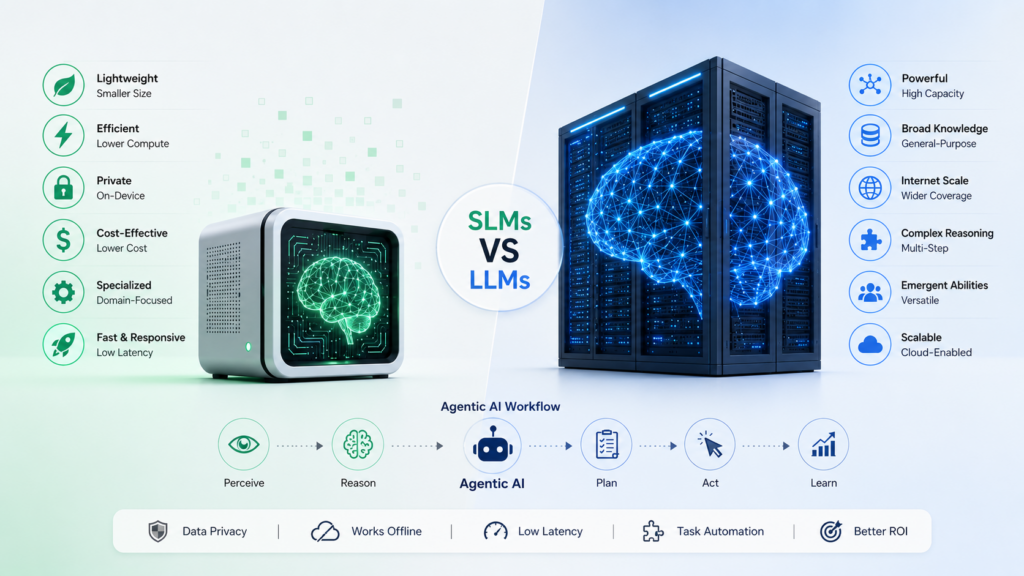
SLMs vs LLMs: The 2026 Shift to
Small Language Models for Agentic AI
Frontier LLMs made agents possible. Small, fine-tuned models are about to make them affordable — and far more reliable in production.
- Most enterprise agent work is narrow and repetitive — parsing, routing, classifying, and producing structured output — not open-ended reasoning.
- NVIDIA Research argues Small Language Models (SLMs) should be the default inside agents, with large models reserved for genuinely hard tasks. SLMs can be 10–30x cheaper to run.
- SLMs win on cost, latency, privacy, and format reliability — but only when they sit on AI-ready data and disciplined orchestration.
- The winning 2026 architecture is heterogeneous: SLM-first, LLM-on-demand.
The quiet tax on every enterprise agent
The first wave of enterprise agentic AI was built on a simple assumption: bigger is better. If a single frontier large language model (LLM) could write code, summarise contracts, and answer customer questions, why not point it at everything? Two years of production reality have exposed the flaw in that logic — and it shows up on the invoice.
Every routine agent step — extracting a field from an invoice, routing a claim, formatting a database query — is billed at frontier-model rates and frontier-model latency, even though the task itself is narrow and predictable. At enterprise volume, that overhead compounds into a structural cost that quietly erodes the business case. It is one reason Gartner predicts more than 40% of agentic AI projects will be cancelled by the end of 2027, citing escalating costs, unclear value, and inadequate controls. Gartner also warns of widespread "agent washing," estimating that only around 130 of the thousands of self-described agentic vendors are the real thing.
What exactly is a Small Language Model?
There is no hard line, but a working definition has settled in the industry: a Small Language Model is one compact enough to run efficiently on commodity or single-GPU hardware while still performing real language tasks — typically in the range of roughly 2 to 12 billion parameters. NVIDIA's paper treats anything under about 10 billion parameters as "small" for agentic purposes. For comparison, the frontier models most agents call today sit between 70 and 175+ billion parameters.
The distinction that matters is not size for its own sake — it is fitness for the job. A model with seven billion parameters that has been fine-tuned to read your invoices and emit clean JSON will beat a 175-billion-parameter generalist on that specific task, every time, at a fraction of the cost. Capability is not one global scale; it is task-by-task. The mistake of the first agentic wave was treating it as global.
What changed: small models grew up
In its 2025 position paper, "Small Language Models are the Future of Agentic AI," NVIDIA Research makes a direct case: SLMs are not just adequate for most agentic tasks — they are the more rational default. The argument rests on how agents actually behave. Agents value reliability over creativity. When a tool expects a specific output format, a small deviation breaks the entire workflow. A compact model fine-tuned to always emit the exact fields, in the exact order, is more dependable on that job than a far larger generalist — and dramatically cheaper.
"Most agentic work is repetitive and narrow… SLMs are well-suited to these specialized, predictable tasks, can be fine-tuned to strict formats, and cost far less per call." — paraphrasing NVIDIA Research, 2025
The economics are the headline. NVIDIA estimates that serving a 7-billion-parameter SLM is roughly 10x to 30x cheaper — in latency, energy, and compute (FLOPs) — than serving a 70-to-175-billion-parameter LLM on the same repetitive task. For an agent fielding millions of calls a month, that is the difference between a pilot that dies in finance review and a deployment that scales. And because smaller models are cheap to fine-tune and quick to retrain, the cost of keeping them accurate as your data drifts is far lower too — an operating-expense advantage that compounds long after launch.
Consider a claims-processing agent. A typical run involves a dozen discrete steps — reading a document, extracting fields, validating against a policy, classifying the claim, and routing it for approval. Only one or two of those steps require real reasoning; the rest are mechanical. Running every step on a frontier model means paying premium rates for clerical work. Reserve the large model for the judgement call, hand the mechanical steps to fine-tuned SLMs, and the same workflow runs faster, cheaper, and with fewer formatting failures — without any drop in the quality of the final decision.
Why SLMs win where it matters for the enterprise
1. Cost that scales the right way
Agentic ROI lives or dies on cost-per-resolved-task. Swapping an oversized model for a fine-tuned SLM on high-frequency steps reduces marginal cost by an order of magnitude — without touching the quality of the output the user actually sees.
2. Latency users can feel
Smaller models respond faster. In multi-step agent chains where a dozen model calls precede a single answer, shaving latency at each hop turns a sluggish experience into a responsive one — critical for customer-facing copilots and real-time operations.
3. Privacy and control by design
SLMs are small enough to run inside your own perimeter — on-premise or in a private cloud — rather than shipping sensitive records to an external API. For regulated sectors such as healthcare, finance, and education, keeping data in-house is not a nice-to-have; it is a precondition for deployment.
4. Format reliability through fine-tuning
Because SLMs are inexpensive to fine-tune, you can lock them to a strict schema for a specific job. That predictability is exactly what production agents need and what unconstrained frontier models, for all their breadth, struggle to guarantee.
| Dimension | Small Language Model | Frontier LLM |
|---|---|---|
| Cost per call | ~10–30x lower (NVIDIA) | Highest |
| Latency | Low | Higher |
| Best at | Narrow, repetitive, structured tasks | Open-ended reasoning, long context |
| Deployment | On-prem / private cloud friendly | Often API-dependent |
| Fine-tuning | Cheap, fast, strict formats | Expensive |
How to migrate an existing agent from an LLM to SLMs
The good news for teams already running LLM-based agents: you do not have to rebuild from scratch. NVIDIA's paper lays out a practical conversion path, and it generalises into a framework any enterprise can follow. The principle is empirical — let real usage tell you which steps actually need a big model, rather than guessing.
- Instrument and log every call. Capture the inputs, outputs, and tool invocations of your live agent. You cannot right-size what you have not measured.
- Secure and clean the data. Strip sensitive fields, deduplicate, and curate the logs into a trustworthy training and evaluation set — inside your own environment.
- Cluster the work by task. Group the agent's calls into recurring patterns: extraction, classification, routing, summarisation, structured generation, and the rare open-ended reasoning step.
- Match each cluster to the smallest model that clears the bar. Most clusters will be served well by an SLM; reserve the LLM only for the clusters that genuinely need it.
- Fine-tune the SLMs to your formats. Train each small model on its cluster so it reliably produces the exact schema the downstream tool expects.
- Measure, then iterate. Compare accuracy and cost against the LLM baseline, promote the winners, and re-run the loop as new usage data accumulates.
Run this loop and the result is not a science project — it is a measurable reduction in cost-per-task with accuracy held constant or improved. That is the kind of evidence that turns a stalled pilot into a funded rollout.
Honest answers to the common objections
"Won't we lose quality?"
Not on the tasks SLMs are assigned. The architecture deliberately keeps the large model for anything open-ended, so the work that needs broad reasoning still gets it. On narrow, format-bound steps, a fine-tuned small model is frequently more reliable than a generalist, because it has fewer ways to go off-script.
"Isn't managing many small models more complex than one big one?"
It is a different kind of complexity, and it is the orchestration layer's job — not yours — to absorb it. Routing, versioning, and fallback logic are exactly what a mature platform handles. The trade is real: slightly more moving parts in exchange for an order-of-magnitude cost reduction and tighter control.
"We don't have an ML team to fine-tune models."
Fine-tuning a small model on a narrow task is dramatically cheaper and simpler than training a foundation model, and increasingly it is a configuration step rather than a research project. This is precisely where a platform partner earns its keep — providing the templates, pipelines, and guardrails so your team focuses on outcomes, not infrastructure.
The catch nobody puts on the slide
Switching to SLMs does not rescue a failing AI program on its own. A small model is only as good as the data it reasons over and the orchestration that surrounds it. MIT's NANDA initiative found that 95% of enterprise GenAI pilots never deliver measurable P&L impact — and the cause is rarely the model. It is fragmented, poorly governed data and the absence of a disciplined layer to route work between models.
That is the real lesson of 2026: the question is not "which single model?" but "which model for which task, grounded in which data?" An SLM fine-tuned on messy, undocumented records will simply fail faster and cheaper. The shift to small models raises the stakes on data readiness and on intelligent orchestration, rather than removing them.
This is also why Gartner's "agent washing" warning matters. Swapping a logo from "LLM-powered" to "SLM-powered" changes nothing if the underlying data is fragmented and the orchestration is a single prompt with no routing, evaluation, or audit trail. The model size is the easy part. The durable advantage comes from the surrounding system — readiness scoring, model routing, monitoring, and governance — that lets small models perform reliably and keeps the whole agent accountable when a regulator or an auditor asks how a decision was made.
The architecture that actually works: heterogeneous, SLM-first
NVIDIA's own framing is not "abandon large models." It is heterogeneous by design: make a fine-tuned SLM the default for routine steps, and escalate to a large LLM only when a task is genuinely open-ended or demands long context. Done well, this gives you the cost and speed of small models with the ceiling of large ones — and a clear, auditable decision about when each is used.
Operationalising that pattern requires three things working together: data that has been scored and prepared for AI; an orchestration layer that routes each step to the right-sized model; and governance — audit trails, access control, and accuracy monitoring — so the whole system stays accountable in production. Get those right and small models become a genuine competitive edge. Skip them and you have simply made your pilot fail more efficiently.
- Map your agent's steps and separate the mechanical majority from the genuine reasoning minority.
- Score your data for AI-readiness before you fine-tune anything — small models amplify data problems, they don't hide them.
- Adopt heterogeneous routing: SLM by default, LLM on demand.
- Fine-tune SLMs to strict output formats for reliability at the tool boundary.
- Keep deployment inside your perimeter for privacy-sensitive workloads.
- Instrument everything — cost-per-task, accuracy, and drift — so value is provable, not asserted.
Build SLM-first agents on your own data
DeepRoot is the platform that makes this architecture real. It scores your data with the Data Readiness Index, routes every step to the right-sized model with built-in SLM–LLM orchestration, and runs inside a secure, audit-ready walled garden — on-premise or private cloud.
Frequently asked questions
What is a Small Language Model (SLM)?
A Small Language Model is a language model compact enough to run efficiently on modest hardware — typically under roughly 10 billion parameters — while still handling narrow, well-defined tasks. In agentic AI, SLMs parse commands, call tools, classify documents, and produce structured output at a fraction of the cost and latency of frontier LLMs.
Are Small Language Models cheaper than large language models?
Yes. NVIDIA Research estimates that serving a 7-billion-parameter SLM is roughly 10x to 30x cheaper — in latency, energy, and compute — than a 70-to-175-billion-parameter LLM on the repetitive, narrow tasks that make up most agentic workloads.
Should enterprises replace LLMs with SLMs entirely?
No. The most effective 2026 pattern is heterogeneous: use fine-tuned SLMs as the default for routine, structured agent steps, and route to a large LLM only for open-ended reasoning or long-context tasks. This balances cost, speed, and capability.
How do you migrate an existing LLM agent to small language models?
Follow an empirical, six-step path based on NVIDIA's conversion framework: log every agent call; secure and clean the data; cluster the calls by task type; match each cluster to the smallest model that clears the accuracy bar; fine-tune the SLMs to strict output formats; then measure cost and accuracy against the LLM baseline and iterate.
Do small language models reduce accuracy in production agents?
Not on the tasks they are assigned. A fine-tuned SLM is often more reliable than a generalist LLM on narrow, format-bound steps because it has fewer ways to deviate. The architecture deliberately routes open-ended reasoning to a large model, so overall quality is maintained while cost and latency fall.
Why do most enterprise GenAI pilots still fail even with the right model?
MIT's NANDA research found 95% of enterprise GenAI pilots deliver no measurable P&L impact, and the cause is rarely the model. It is fragmented, poorly governed data and a lack of disciplined orchestration. Small models amplify data problems rather than hiding them, so data readiness and governance remain decisive.
Sources & further reading
- Belcak, P., Heinrich, G., et al. "Small Language Models are the Future of Agentic AI." NVIDIA Research, 2025. arxiv.org/abs/2506.02153
- Gartner. "Gartner Predicts Over 40% of Agentic AI Projects Will Be Canceled by End of 2027." Press release, June 25, 2025. gartner.com
- MIT NANDA. "The GenAI Divide: State of AI in Business 2025." Report PDF
- Related reading on Innoflexion: Multi-Agent Orchestration: Enterprise GenAI Architecture 2026 · Why Enterprise AI Agents Fail in Production