
Beyond RPA: Architecting Agentic AI and AI Digital Twins for the Enterprise
The transition from deterministic scripts to probabilistic reasoning is fundamentally altering enterprise architecture. Discover how Agentic AI and AI Digital Twins are delivering continuous, resilient operational automation, and how to govern the transition.
For the past decade, Chief Information Officers and Engineering VPs have relied on Robotic Process Automation (RPA) to stitch together fragmented enterprise systems. The fundamental flaw of RPA is its fragility: it is highly deterministic. If an ERP updates its user interface, or an API payload structure changes by a single character, the bot breaks, resulting in costly downtime, stalled operations, and a massive technical debt backlog.
The enterprise AI landscape of 2026 solves this fragility through cognitive execution. We have officially moved beyond generative copilots that require constant human prompting. Today, market leaders are abandoning brittle scripts and deploying Agentic AI and AI Digital Twins—autonomous systems capable of parsing ambiguity, planning dynamically, and executing complex workflows robustly.
Business leaders are no longer investing in rigid rules engines; they are deploying agentic AI to autonomously reconcile financial ledgers, dynamically re-route supply chains, and self-heal cloud architectures. Because these agentic AI systems drive unprecedented, unsupervised scale, capturing their true ROI requires deep technical alignment and robust human-in-the-loop AI governance to ensure absolute enterprise trust.
The Evolution of Enterprise Execution
To understand the disruptive value of this shift, we must look at how automation architecture has evolved and why legacy methods are no longer sufficient for modern scale.
| Execution Model | Technology Paradigm | Failure Point | Primary Business Value |
|---|---|---|---|
| RPA (Legacy) | Deterministic / Rule-based scripting | Breaks upon UI/UX or API payload changes. High maintenance. | Basic task automation for highly repetitive data entry. |
| GenAI Copilots | Probabilistic / Suggestive (RAG) | Requires continuous human prompting and verification. | Individual employee productivity and content generation. |
| Agentic AI | Autonomous / Goal-oriented reasoning | Unsupervised API execution requires strict governance guardrails. | Enterprise-wide autonomous workflow execution and self-healing systems. |
The Technical Anatomy of Agentic AI
Agentic AI: A goal-driven artificial intelligence system that utilizes LLMs as reasoning engines, paired with tool-calling capabilities (APIs), memory persistence, and dynamic planning algorithms (such as ReAct) to execute multi-step enterprise tasks without continuous human prompting.
Building production-ready agentic AI is significantly more complex than wrapping a chatbot around an API. True agentic AI development requires a sophisticated cognitive architecture comprising four critical layers:
- Cognitive Orchestration (ReAct Loops): Agentic AI uses "Reasoning and Acting" (ReAct) frameworks. Instead of executing a blind script, the model reasons through a problem, acts (calls an API), observes the output, and adjusts its next step dynamically. It uses Directed Acyclic Graphs (DAGs) to map complex workflow dependencies.
- Stateful Memory & Knowledge Graphs: An enterprise workflow might take days to complete. Agentic AI relies on high-dimensional Vector Databases for long-term memory. More importantly, it uses Enterprise Knowledge Graphs to understand complex relationships (e.g., mapping how a delay from Supplier A impacts Product C's delivery date).
- Deterministic Actuation (Function Calling): While the reasoning is probabilistic, the execution must be deterministic. Agentic AI translates its intent into strict JSON payloads mapped to your organization's OpenAPI specifications, triggering live actions in systems like SAP, Salesforce, or AWS.
- Governance-as-Code: This involves establishing strict runtime boundaries and semantic routers that prevent an agentic AI model from making unauthorized lateral movements across your tech stack.
AI Digital Twins: The Agentic Simulation Sandbox
Handing over direct database write-access to a probabilistic model is a massive operational risk. This is where AI digital twins become the most critical component of the modern AI tech stack.
Historically, digital twins were physical replicas of machinery (like a jet engine). Today, AI digital twins are virtual representations of an organization's logic, data states, and human workflows. Rather than simulating physical environments, AI digital twins simulate enterprise logic.
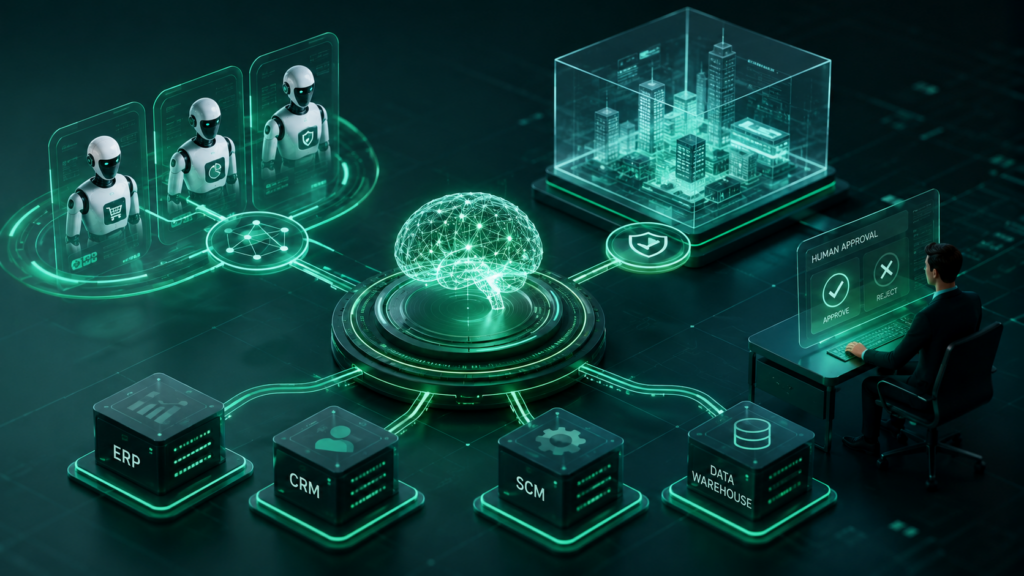
In a mature architecture, an agentic AI model does not immediately execute a critical task in production. Instead, it tests its hypothesis against the AI digital twin.
The Trigger: A critical global shipping route is blocked, delaying thousands of components.
The Legacy (RPA) Approach: An RPA bot flags the delay, throws a system error, and stops. A human team spends 72 hours manually recalculating logistics, calling vendors, and updating purchase orders.
The Agentic AI Approach: The agentic AI detects the delay. It immediately formulates three alternative logistical plans. It feeds these plans into the AI digital twin, which simulates the financial cost, delivery latency, and vendor availability for each option. The AI digital twin determines that Option B yields the highest margin. The agentic AI then drafts the necessary JSON payloads to re-route the shipment, queuing the final API calls for immediate human approval.
Federated Execution: The Multi-Agent Swarm
We have officially reached the end of the single monolithic model. Complex operations are orchestrated through federated, multi-agent architectures. In this model, specialized AI digital twins collaborate, passing structured data payloads back and forth.
Consider an automated procurement cycle powered by a swarm of agentic AI:
- The Analyst Twin: An AI digital twin that continuously monitors inventory levels and predictive demand models.
- The Strategist Twin: An agentic AI node that receives low-inventory alerts, evaluates global suppliers, and negotiates terms via automated email endpoints.
- The Compliance Twin: A gatekeeping AI digital twin that audits the Strategist's proposed contract against enterprise legal policies before routing it for human signature.
This distributed agentic AI architecture reduces token bottlenecks, lowers compute costs, and isolates failure domains—ensuring an error in one node does not corrupt the entire workflow.
The Economics: Justifying Agentic AI Development
For the C-suite, adopting agentic AI and AI digital twins is ultimately an economic decision. Traditional automation scales linearly: more tasks require more RPA licenses, more maintenance engineers, and a more rigid infrastructure.
Agentic AI introduces non-linear scalability. The primary cost shifts from human maintenance hours to API token consumption and compute power. Because AI digital twins can dynamically self-heal workflows when an endpoint changes, the technical debt associated with broken scripts drops by an estimated 75%. Furthermore, by utilizing localized, domain-specific small language models (SLMs) for sub-tasks within the swarm, enterprises can keep inference costs extraordinarily low while maintaining high execution accuracy.
Risk Mitigation: Human-in-the-Loop AI & The Escalation Matrix
Scaling agentic AI safely requires absolute control over the decision-making lifecycle. In highly regulated sectors like finance and healthcare, unsupervised autonomous execution is a compliance violation. The NIST AI Risk Management Framework (AI RMF) explicitly mandates deterministic safety mechanisms—this is where human-in-the-loop AI becomes a non-negotiable architectural layer.
Human-in-the-loop AI is not a limitation on automation; it is a strategic safety net. It guarantees that an enterprise retains legal, ethical, and financial accountability for every action executed by an AI digital twin. By explicitly defining where the AI's autonomy ends and human judgment begins, leaders can deploy agentic AI without exposing the enterprise to catastrophic API errors.
How does this work in a live production environment? Enterprise platforms engineer agentic AI with strict confidence thresholds, role-based access control (RBAC), and dynamic escalation matrices.
- Scenario A (Autonomous Execution): If an AI digital twin updates an internal CRM record or parses an invoice with 99% confidence, it executes silently in the background, driving massive operational velocity.
- Scenario B (HITL Triggered): If the agentic AI attempts a task with high systemic impact—such as authorizing a $50,000 vendor payment or altering a secure IT policy—or if its ReAct loop returns a low confidence score, execution is instantly suspended at the API gateway layer.
Upon suspension, the platform packages the system's logic trace, the proposed JSON payload, and the AI digital twin simulation results, routing them to the appropriate human manager via a secure UI. Once the human reviews and approves (or corrects) the action, the agentic AI resumes the workflow, logging the human's feedback to fine-tune future model behavior. This sophisticated human-in-the-loop AI pipeline ensures flawless compliance while preserving the speed of autonomous execution.
How Innoflexion Engineers Autonomous Enterprises
Off-the-shelf LLM wrappers and generic chatbots cannot support mission-critical workflows. At Innoflexion, we engineer bespoke agentic AI ecosystems designed specifically for your proprietary tech stack and operational constraints. Here is our blueprint for building the digital workforce of the future:
-
Role-Specific AI Digital Twins
We map your most complex human workflows to construct AI digital twins. Rather than relying on generic models, these are trained exclusively on your data moats, requiring a strict Data Readiness Assessment to ensure your enterprise knowledge graphs and historical decision logs are AI-ready.
-
The Agentic Workbench & API Gateways
We deploy secure API gateways and centralized observability workbenches. This equips your IT leadership with real-time telemetry on every API call your agentic AI attempts, fortified with automated rollback capabilities.
-
Hardwired Human-in-the-Loop Guardrails
We embed human-in-the-loop AI routing directly into the cognitive architecture. Low-risk operations run autonomously, while high-stakes decisions and ambiguous edge cases trigger immediate, contextual human escalation.
-
Private Data Sovereignty
True agentic AI development requires deep data integration. We deploy these architectures within a strict Zero Data Leakage framework—whether on-premise or in a Virtual Private Cloud (VPC)—guaranteeing your intellectual property never trains public foundational models.
Is Your Enterprise Ready for Autonomous Execution?
Do not let fragmented data, fragile RPA scripts, or a lack of API governance delay your operational evolution. Start by evaluating your underlying data infrastructure to map out the exact architectural steps required to deploy secure Agentic AI and robust AI Digital Twins.
Frequently Asked Questions
How does Agentic AI differ from RPA?
RPA is deterministic; it relies on rigid scripts and breaks when a UI or process changes. Agentic AI is probabilistic; it understands the end goal and can autonomously navigate changing environments, APIs, and data structures to achieve that objective.
What role do AI Digital Twins play in agentic architecture?
AI Digital Twins provide a risk-free simulation environment mapped to enterprise knowledge graphs. Before an agentic AI system executes a high-stakes API call in production, it tests its hypothesis against the AI digital twin to validate the business outcome.
Why is human-in-the-loop AI necessary?
Human-in-the-loop AI acts as a mandatory guardrail for high-stakes decisions. It ensures that when agentic AI encounters ambiguity, or attempts an action that exceeds its security clearance, a human reviewer retains final operational authority.