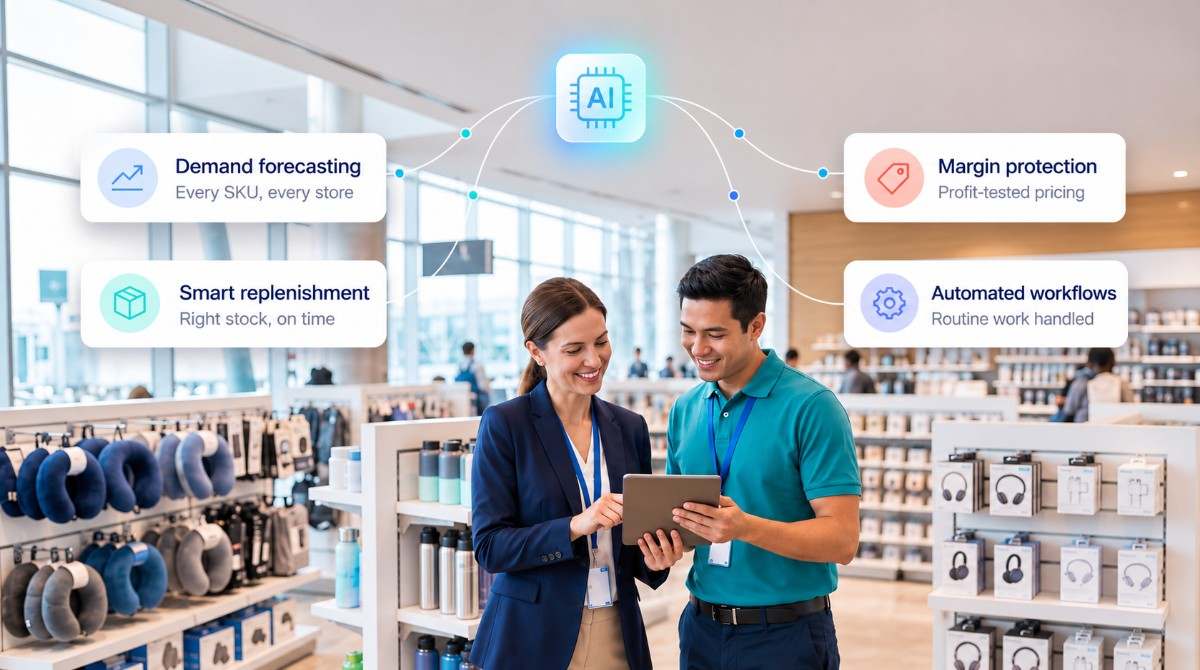
- Grow Revenue
- Protect Margins
- Optimize Inventory
- Improve Efficiency
Retail Has Evolved, Operations Haven’t
Retail margins leak in two places: at head office, where plans still rely on static budgets and flat averages, and on the shop floor, where systems can’t see what’s actually on the shelf.

Planning & Forecasting Challenges
-
01
Buying Runs on Optimistic Forecasts
Budgets are set once a year, buyers inflate requests to protect sales, and merchandisers have no open-to-buy limit to push back with.
Months of excess stock, cash locked in slow sellers
-
02
Ranges Maintained by Hand, Store by Store
Range decisions live in spreadsheets with no link to each store's space, so small stores are overloaded and large ones underused.
Cluttered shelves, missed sales, heavy markdowns
-
03
Replenishment Reacts Too Late
Reorders triggered by declining sales or stockouts fail to account for inventory in transit, demand shifts, and supplier lead times.
Prolonged stockouts, lost sales, and dissatisfied customers
-
04
Too Much Inventory, Not Where It Matters
Aggregate inventory reports mask store-level shortages and excess, triggering unnecessary purchases while available stock sits elsewhere.
Lost revenue, higher carrying costs, and inefficient inventory allocation
Store Operations Challenges
-
01
Ordered One Thing, Received Another
The vendor ships one quantity, the system records another, and nobody checks the delivery against the purchase order.
Paying for stock that never arrived, and inventory that never matches
-
02
Stocked in the System, Lost at the Shelf
Each store is one location in the ERP, so associates can't see whether stock is on the shelf, in the storeroom, or gone.
Phantom stock, wasted storeroom trips, lost sales
-
03
Stock Moves Between Stores Off the Record
Where sister stores share storage, a formal transfer means scanning twice, so staff carry stock across and skip the system.
Drifting balances and losses no one can trace
-
04
Food-Safety Records Kept on Clipboards
Cooler temperatures are logged on paper, out-of-range readings go unexplained, and fresh waste is barely recorded.
Gaps when an inspector asks for quarterly readings

From Open-to-Buy to the Store Shelf
Buy and stock to real demand, see every unit in store, automate routine decisions with AI agents, and get your data AI-ready with DeepRoot, all on the ERP you already run.
Merchandising Solutions
Merchandise financial planning, assortment, replenishment, and availability tracking in one connected solution. Buyer forecasts are tied to open-to-buy and tracked through to every SKU, store, and time dimension, ready for AI agents to build on.
Rolling Forecasts Locked to Open-to-Buy
Less cash tied up in excess stock Open-to-buy is calculated from opening stock, planned sales, and the closing-stock target. A plan that would push stock above the target cannot be saved, so buyers commit only the spend the business has approved.
Buying based on real demand Buyer sales forecasts flow straight into open-to-buy and are converted to cost at the latest actual trading margin, so every purchase is backed by a realistic forecast rather than an optimistic estimate.
Budgets that keep up with trading Sales are re-forecast on a rolling basis throughout the year, so purchase budgets rise or fall with actual performance instead of staying fixed to an annual plan.
Planning without spreadsheets Approved plans are broken down automatically by sub-planning group, store, and time dimension. New stores borrow the profile of a similar store, and closing stores stop receiving stock on their cut-off date.

Assortment Planning and Allocation
The right assortment for every store Each store is graded by its selling space, and styles assigned to a grade flow automatically to every store in that grade. Small stores are not overloaded, and large stores are not left with empty space.
One controlled process across all stores Assortment decisions move out of individual spreadsheets into one shared workflow. Local exceptions can be set at any level of the store hierarchy, and every change is recorded for audit.
Display stock that matches selling space Facings and depth define how much stock each store needs on display, and that figure becomes its replenishment target, so inventory is invested only where it can be sold.
Demand-Driven Replenishment
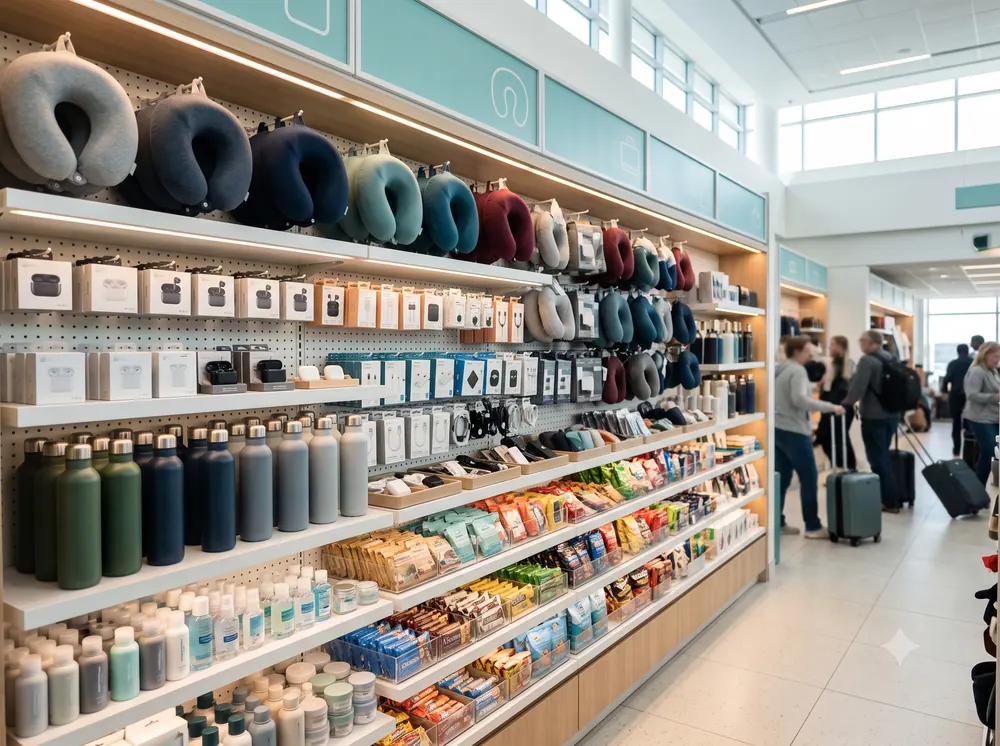
Stockouts prevented before they happen For every SKU in every store, the solution compares a rolling forecast with stock on hand, in transit, and on order. Planners see a shortfall early, before a shopper finds an empty shelf.
Less overstock and fewer emergency orders Weeks of cover and net demand appear side by side, so planners order only what each store actually needs instead of padding orders to stay safe.
Vendor-ready orders, rounded to MOQ and case pack Suggested order quantities are rounded to each vendor’s minimum order quantity (MOQ) and case-pack multiples. Planners can review or override them by store on the same screen before the order is released.
One plan for every supply route Lines supplied through the distribution center and lines delivered direct to store are planned together, with delivery dates based on each vendor’s actual lead time.
Availability Tracked by SKU, Store, and Time Dimension
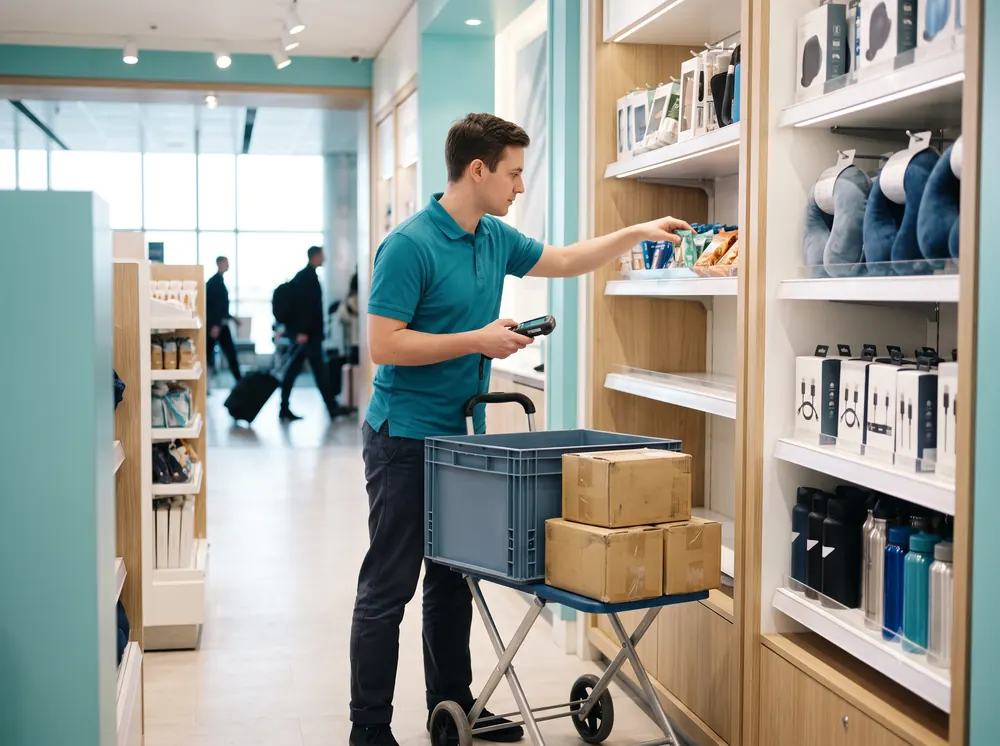
Store-level gaps no longer hidden Availability is measured for every SKU in every store against its display target, for any time dimension. Teams can drill from a category total down to a single store, so a surplus in one store can no longer mask a stockout in another.
No reordering stock that is already on the way Stock in transit, being picked, or allocated at the distribution center appears next to every gap, so planners act only where no help is already coming.
Aged stock cleared before it becomes a write-off Closing stock is tracked against the open-to-buy target, and aged, end-of-life, and clearance lines are flagged by merchandise area, style, and store so they can be exited in time.
Figures the business can trust Before reports are produced, non-sales transactions are removed, returns are netted off, and negative stock is corrected, so availability and margin figures are accurate.

Store Operations
A mobile store operations app for store associates that manages inventory across the sales floor and the backroom, from goods receiving and backroom inventory to fresh food and FDA compliance. Most ERPs track a store as a single location, with no visibility of stock moving between backroom and shelf. The app closes that gap and keeps ERP inventory accurate.
Scan and Receive Deliveries in Seconds
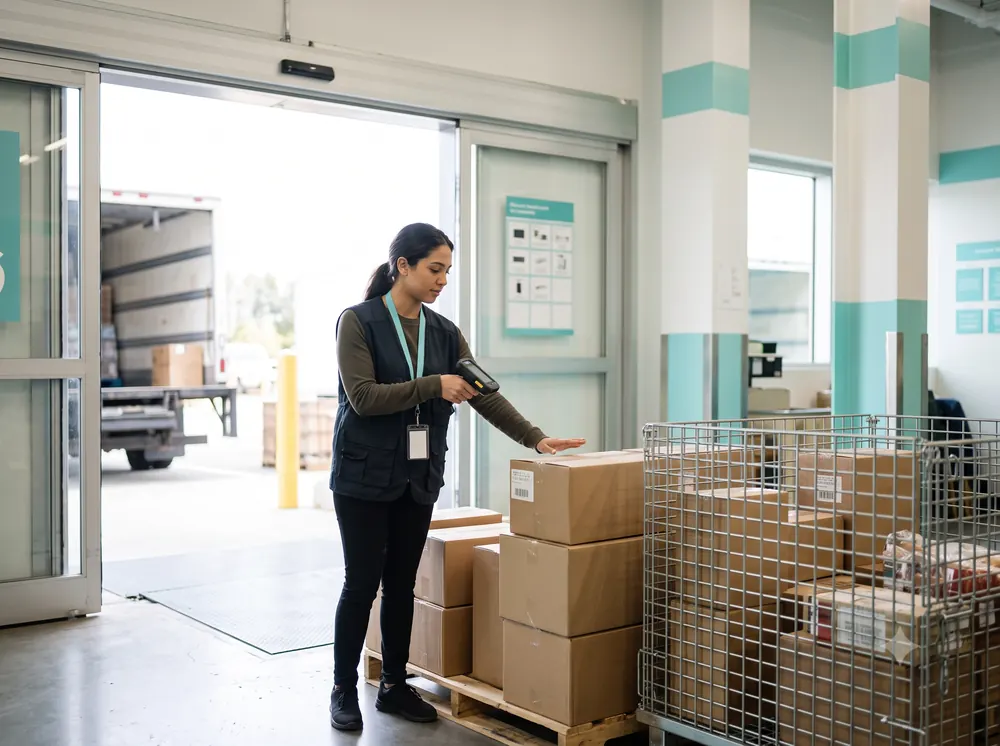
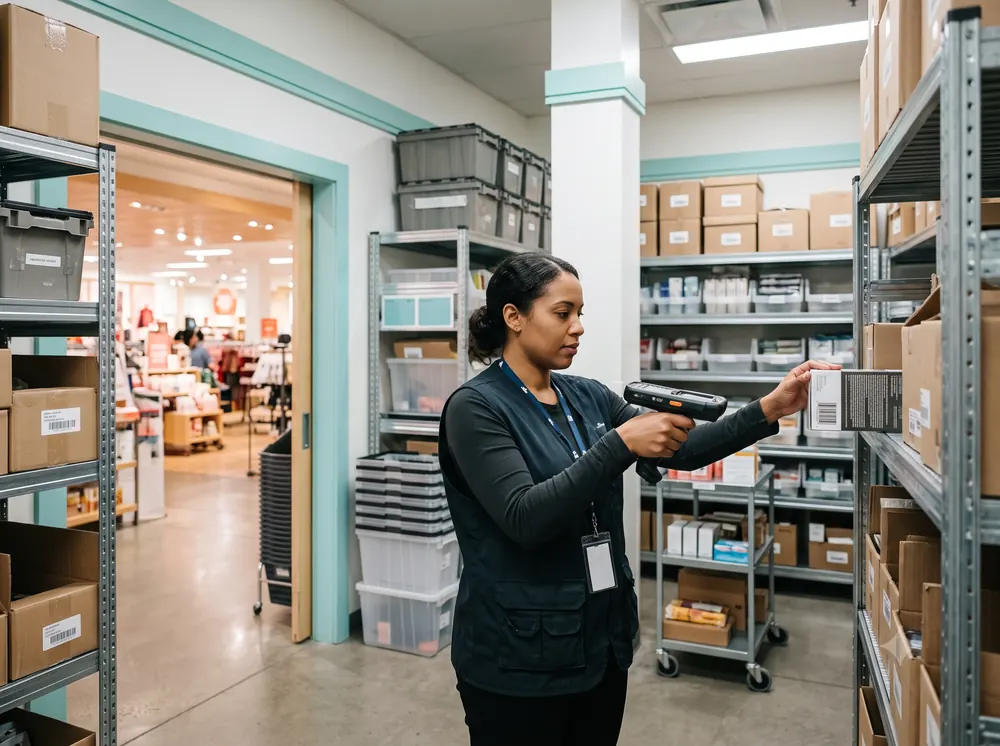
Faster receiving with less training Associates scan items or cartons on a handheld device in a simple, guided flow instead of working through multiple desktop screens. Deliveries are received in seconds, and temporary staff become productive quickly.
Pay only for what was delivered Each delivery is checked item by item against its purchase order, and receiving more than was ordered is blocked, so vendors are paid only for what actually arrived.
Delivery problems resolved at the door If a delivery is short, partial, or split, the mismatch is flagged the moment it is scanned and routed into an exception workflow, instead of surfacing weeks later.
Inventory that is accurate in real time Receipts update ERP inventory within seconds. An offline mode keeps receiving running where connectivity is poor and syncs once the connection returns.
Location-Level Inventory, From Backroom to Shelf
Sales no longer lost to hidden stock Stock on the sales floor and in the backroom is tracked separately, so associates can see whether an item is truly sold out or simply waiting to go on the shelf.
Instant answers for associates One scan with Price Lookup or Inventory Lookup shows the price and the stock on the floor, in the backroom, in transit, at the distribution center, and at nearby stores.
Shrink that can be traced Every move from backroom to shelf is recorded by scan without extra ERP transactions, so when stock goes missing, the team can see where it was last recorded.
Shared Backroom Picks with Automatic Inter-Store Transfers
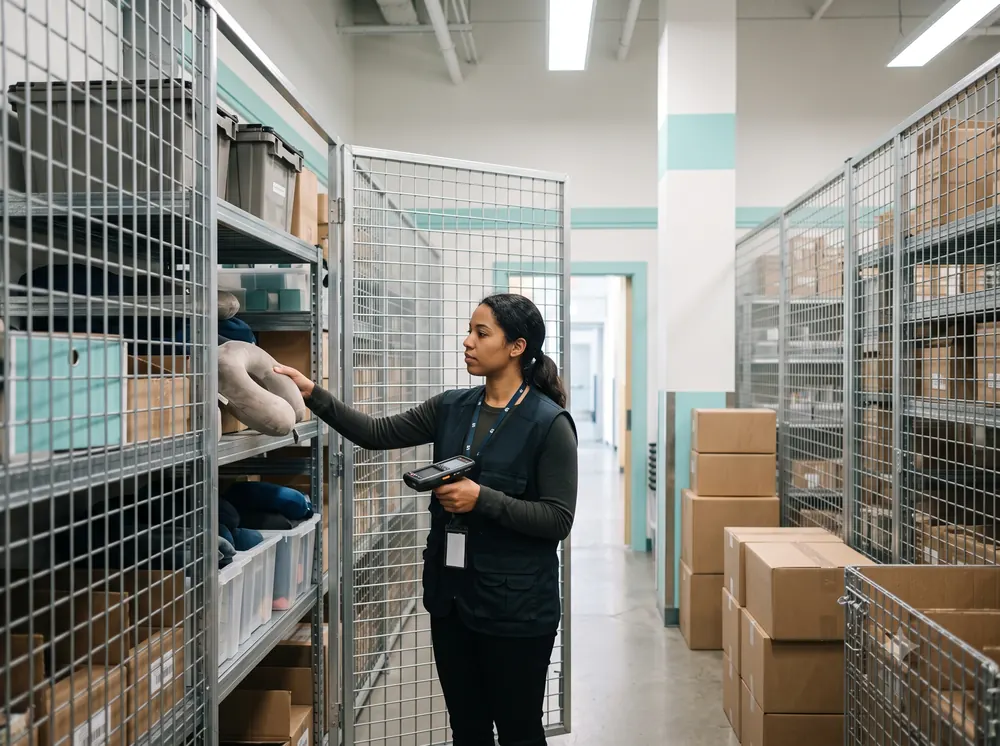
Sales completed even when the shelf is empty In shared backrooms, such as those at major airports, associates can pick stock allocated to a neighboring store and complete the sale on the spot.
Half the scanning effort A single scan records both the dispatch from one store and the receipt at the other, so both stores no longer need to scan the same items.
Accurate stock for both stores Stock is confirmed at the sending store before it is picked, and every transfer is posted to the ERP, keeping both stores’ inventory correct.
Fresh Food and Cold-Chain Control
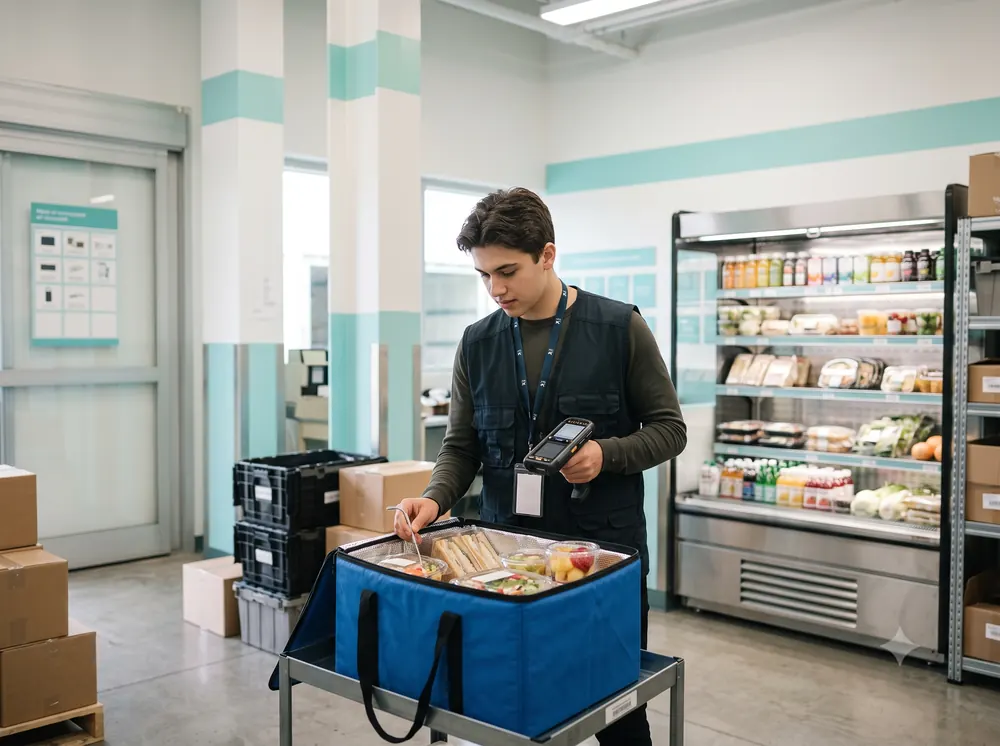
Cold chain checked at delivery Chilled and fresh deliveries are temperature-checked as they are received, so any break in the cold chain is caught before the product reaches the shelf.
A true picture of fresh waste Spoiled and expired products are recorded separately with a reason code, showing how much is wasted and why, so ordering and handling can be improved.
Fewer errors from temporary staff Clear icons and simple scan steps make fresh waste easy to record correctly, even for seasonal and temporary teams.
FDA-Ready Food-Safety Compliance
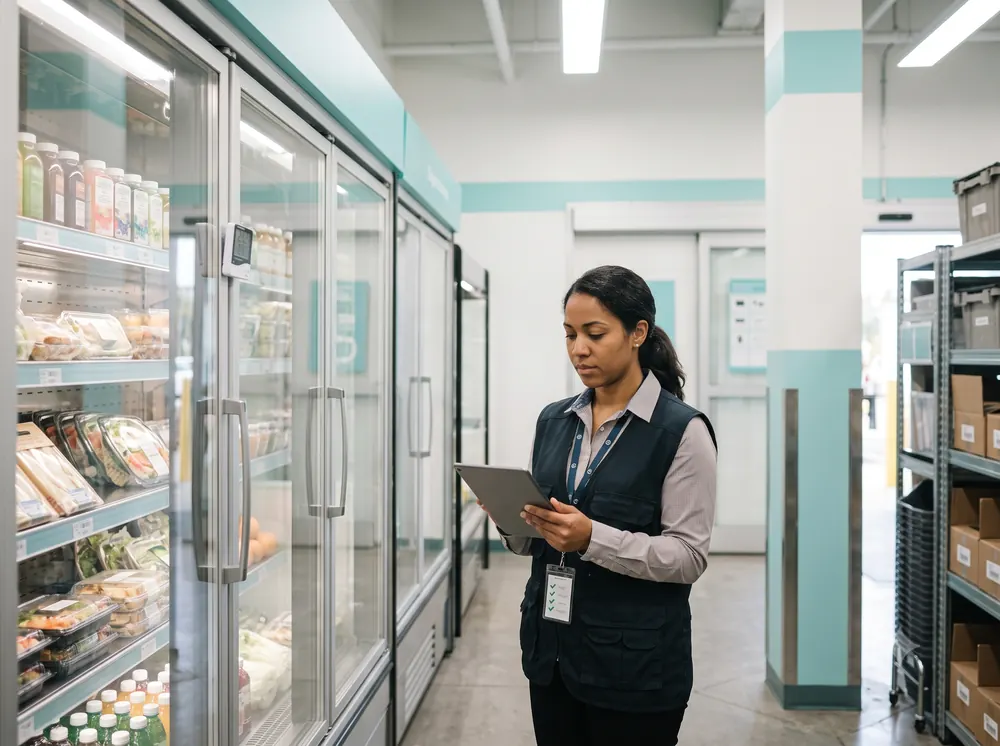
Temperatures recorded at every check Associates scan a QR code on each chiller, freezer, and display case holding fresh food at every scheduled check, such as store opening and closing. Any missed check is flagged immediately.
An audit trail that cannot be altered Each reading is time-stamped and locked once submitted. If a temperature is out of range, a corrective action must be recorded, building a complete history that proves compliance.
Ready for inspection at any time Readings, delivery temperatures, and corrective actions can be viewed and exported for any time dimension an inspector requests, with no paper logs to collect.
Automation & AI Agents
Each AI agent is a digital twin of one of your planning roles. It works around the clock on the same data your team uses and handles the routine decisions, around 80% of the workload, within limits you set. The remaining 20% goes to your team with the analysis already done.
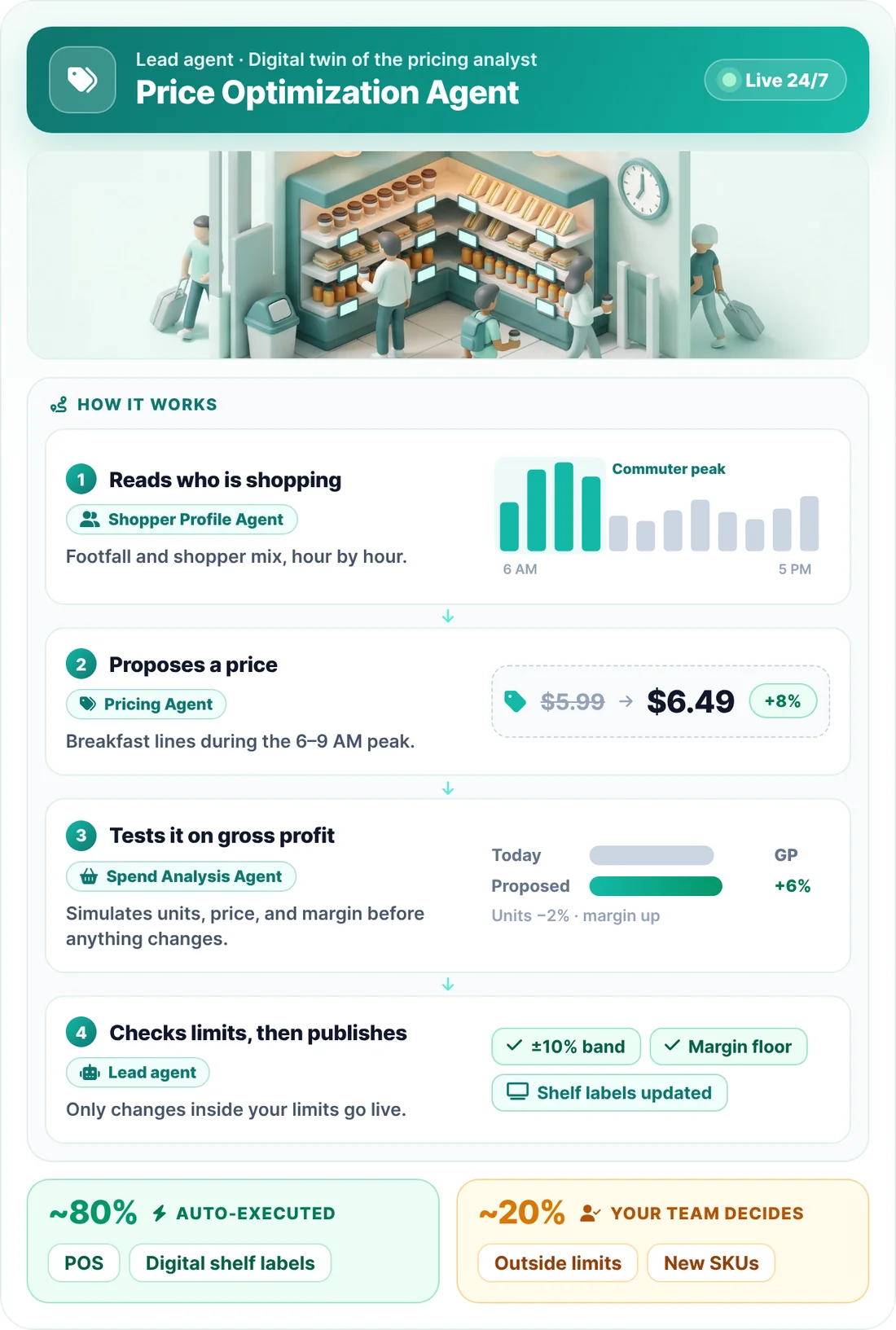
Price Optimization Agent
Higher margin from the same footfall Prices adjust to footfall, time of day, and shopper mix in each store. A morning commuter rush and a quiet afternoon no longer share one price, so the business captures what shoppers are willing to pay.
Every price change protects profit Before any change goes live, the agent simulates its effect on gross profit, so margin is never given away just to sell more units.
Price changes in hours, not weeks Approved prices are pushed to POS and digital shelf labels across hundreds of stores automatically, with no manual relabeling.
Automation with full control The agent works within the price band and margin floor you set. Any change outside those limits goes to the pricing team with the analysis already done.
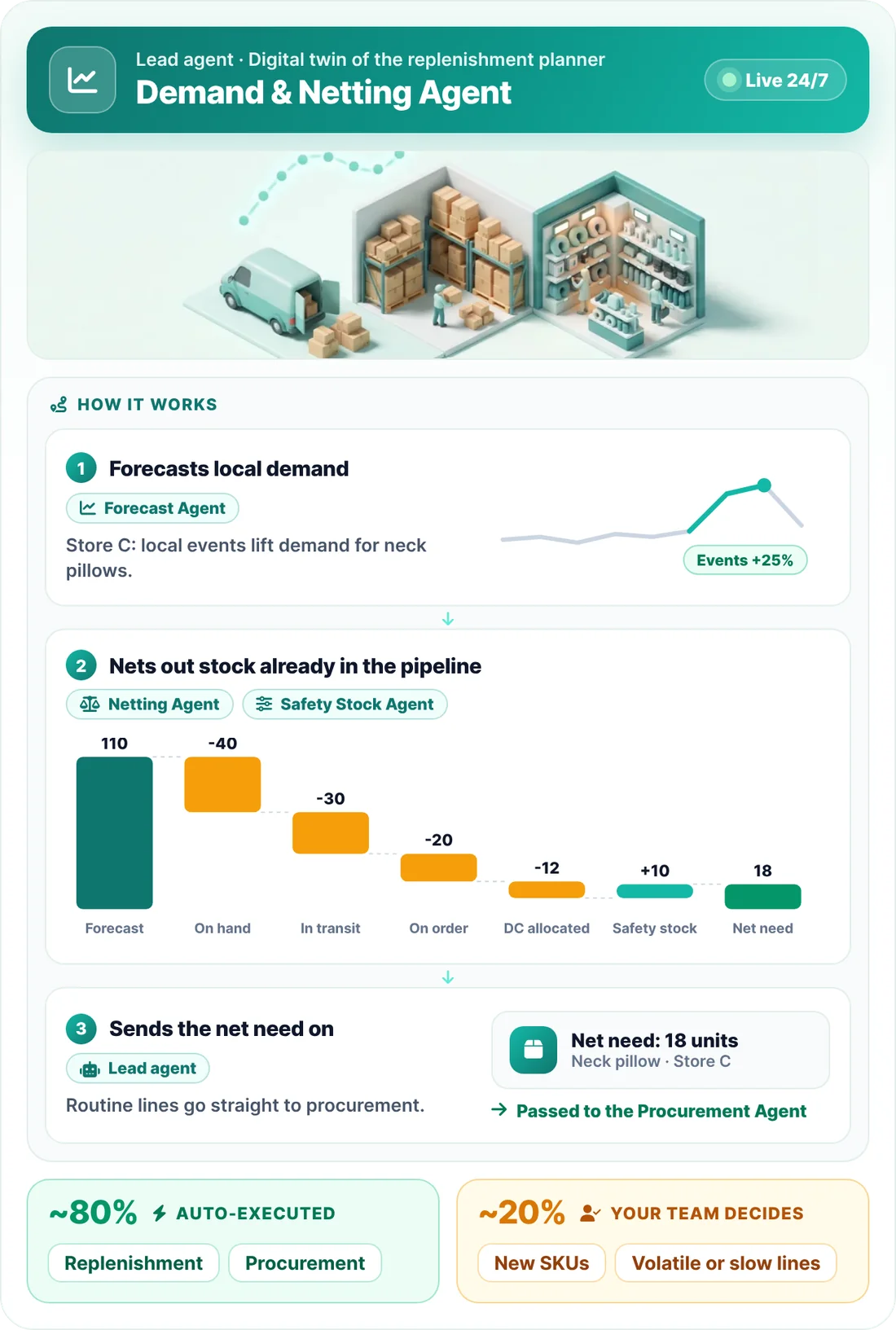
Demand & Netting Agent
Fewer stockouts on key lines Demand is forecast for every SKU in every store using footfall, conversion, and basket value, so stock follows local demand instead of a chain average.
No duplicate or excess orders Before anything new is ordered, the agent deducts stock on hand, in transit, on order, and allocated at the distribution center.
Less cash tied up in safety stock Safety stock is set by each line’s demand volatility, vendor reliability, and lead time, instead of one blanket buffer that overstocks slow sellers.
Ready for peaks, clean at exit Stock is built up ahead of local and national events and run down to zero for lines that are being discontinued.
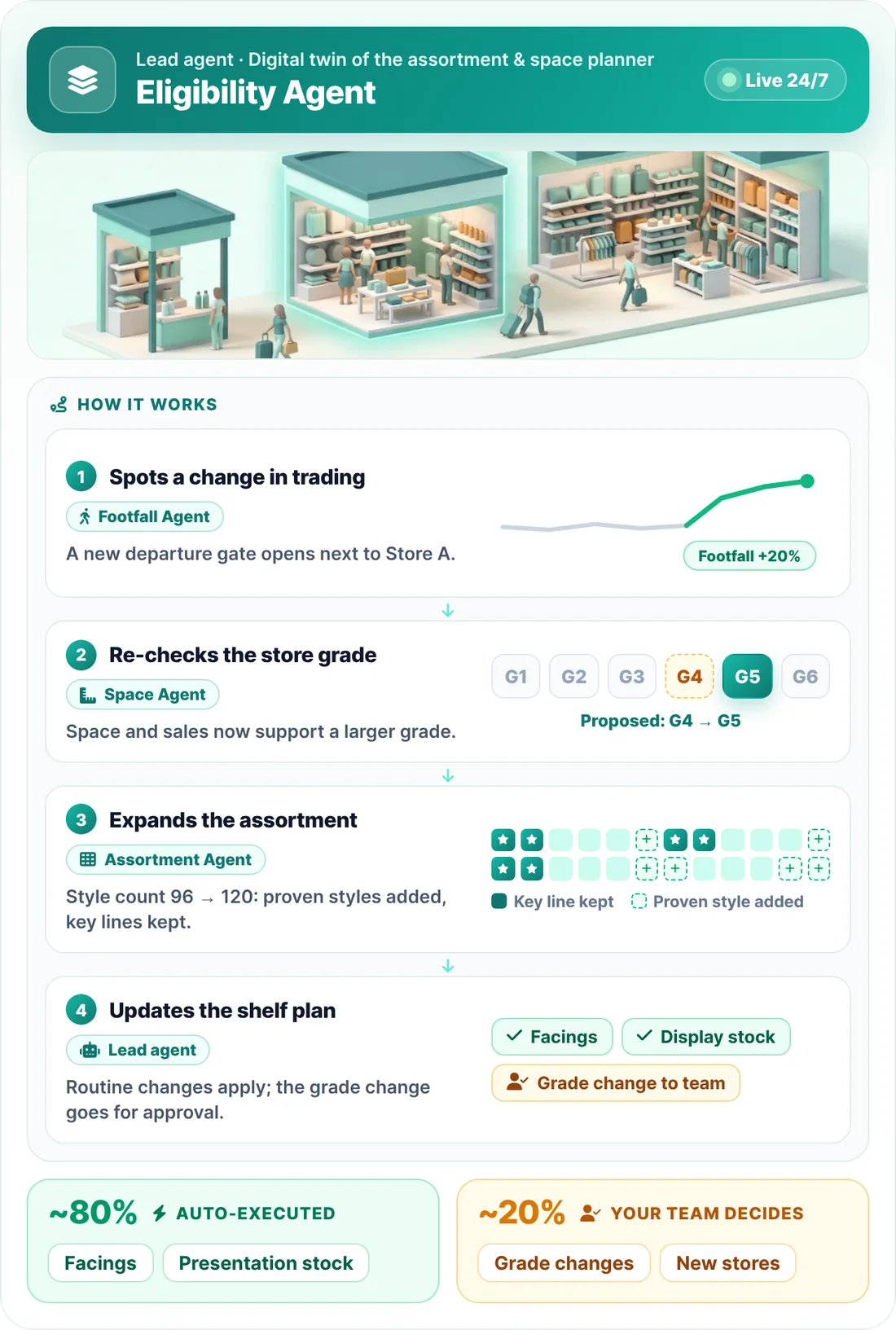
Eligibility Agent
Assortments that fit every store Store grades are kept up to date with each store’s floor space, shelf space, footfall, and rate of sale, so every store carries an assortment it can sell.
Action before sales drop Events such as a renovation, a neighboring tenant closing, or a change in traffic trigger a proposed re-grade before sales are affected.
Shelf space for proven sellers When a store moves to a smaller grade, the slowest styles are removed first and every key line is kept.
Local exceptions without rework Store-specific exceptions are applied without deleting existing allocations or restarting the plan.
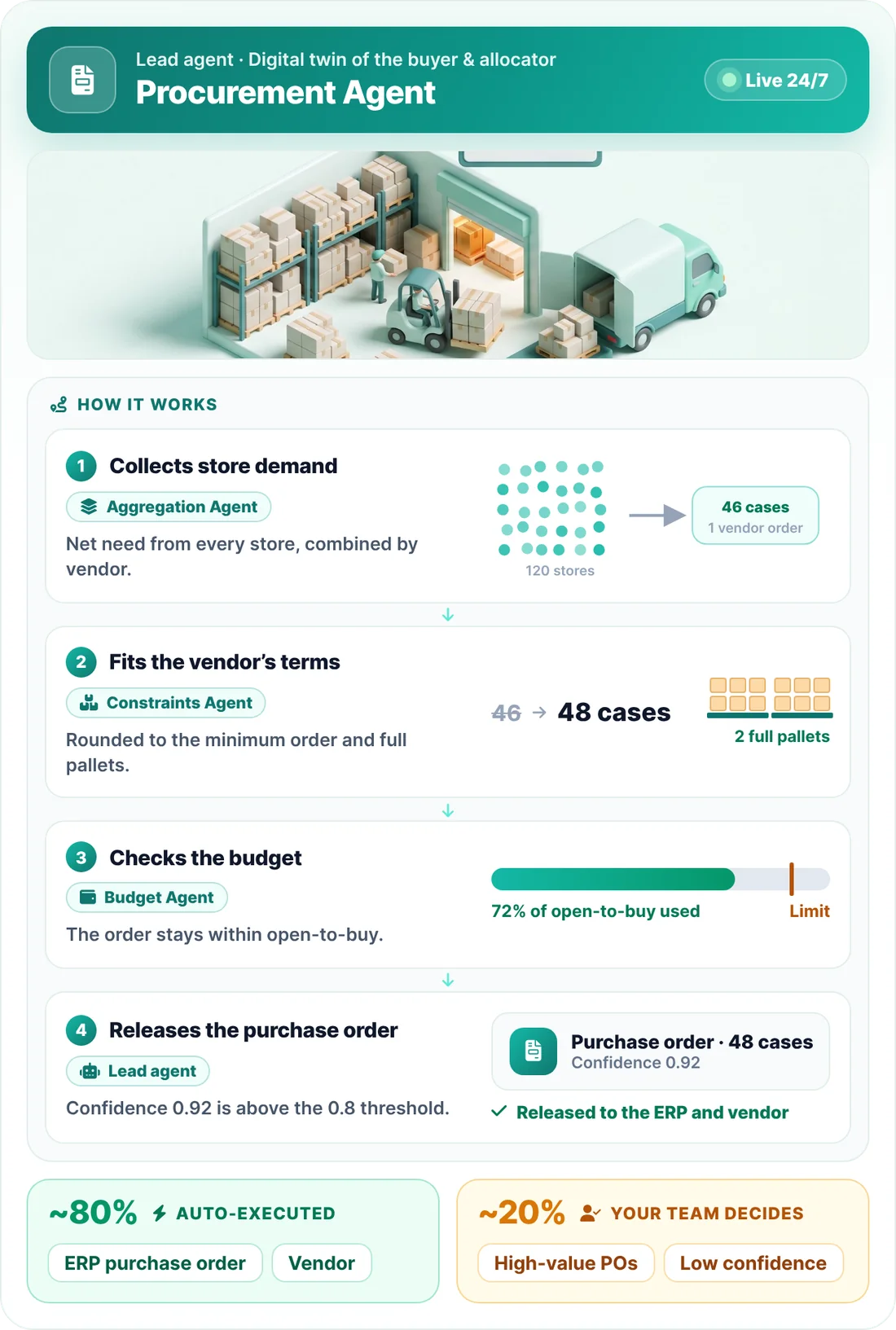
Procurement Agent
Lower ordering and freight costs Demand from hundreds of stores is combined into fewer, fuller orders, rounded up to full pallets and cases where the savings justify it.
Vendor-compliant purchase orders Every purchase order is validated against the vendor’s minimum order quantity (MOQ), case-pack and pallet configuration, and lead time before it is transmitted.
Spending that stays within plan Open-to-buy limits are applied to every order, and routine purchase orders are placed in the ERP automatically, around the clock.
Buyers focused on the orders that matter High-value or uncertain orders reach buyers with the supporting analysis and a confidence score, ready to approve in one step.
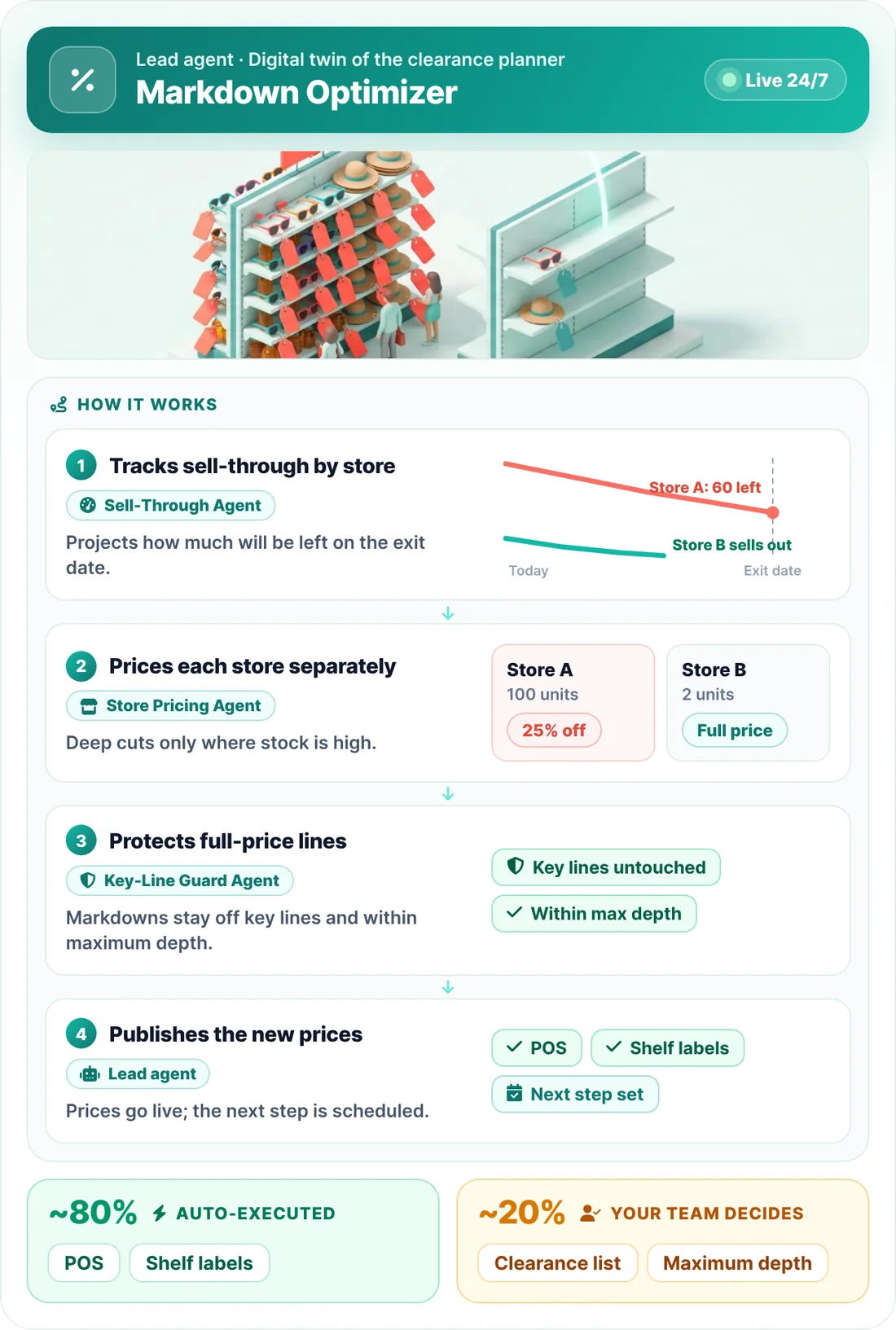
Markdown Optimizer
Slow sellers spotted early Sell-through is tracked continuously for every clearance SKU, showing how much stock will be left by the exit date if nothing changes.
Less margin given away in clearance Discounts are set store by store based on local stock and rate of sale, with deep cuts only where stock is high.
Full-price sales protected The depth and timing of each markdown are set so clearance does not draw shoppers away from full-price key lines.
Planners freed for higher-value work The long tail of low-value SKUs is cleared from start to finish without manual effort, so planners can focus on the lines that drive profit.

The AI Platform Across the Suite
DeepRoot.ai, our AI platform, supports our merchandising solutions. It starts with data readiness and keeps your people in control.
Data Readiness Index
Scores data quality and AI fitness before any build begins.
Connects to Your Stack
Reads from SAP, Oracle, Aptos, Manhattan Associates, and more.
Agentic Workflows
Detects issues, drafts responses, and escalates exceptions.
Data Privacy & Security
Runs in your cloud or on-premises; data never trains public models.
Human in the Loop
Markdowns, vendor approvals, and refunds need your team's sign-off.
Conversational Analytics
Ask your live sales and stock data questions in plain language.
Proven in Live Retail Operations
How a North America-based retail giant with 400+ airport, resort, and travel stores put our merchandising and store operations solutions to work.

From Annual Spreadsheets to One Governed Merchandise Plan
The scenario: Five to seven months of stock sat on hand, yet best sellers still ran out in the busiest stores. Budgets were set once a year in spreadsheets, buyers over-requested stock to protect sales, and reporting stopped at category level.
What we did differently: We fixed the data first with a codified merchandise hierarchy and a cleansed data layer. Then we linked every buyer’s sales forecast to the merchandiser’s open-to-buy and automated each plan down to store and week.
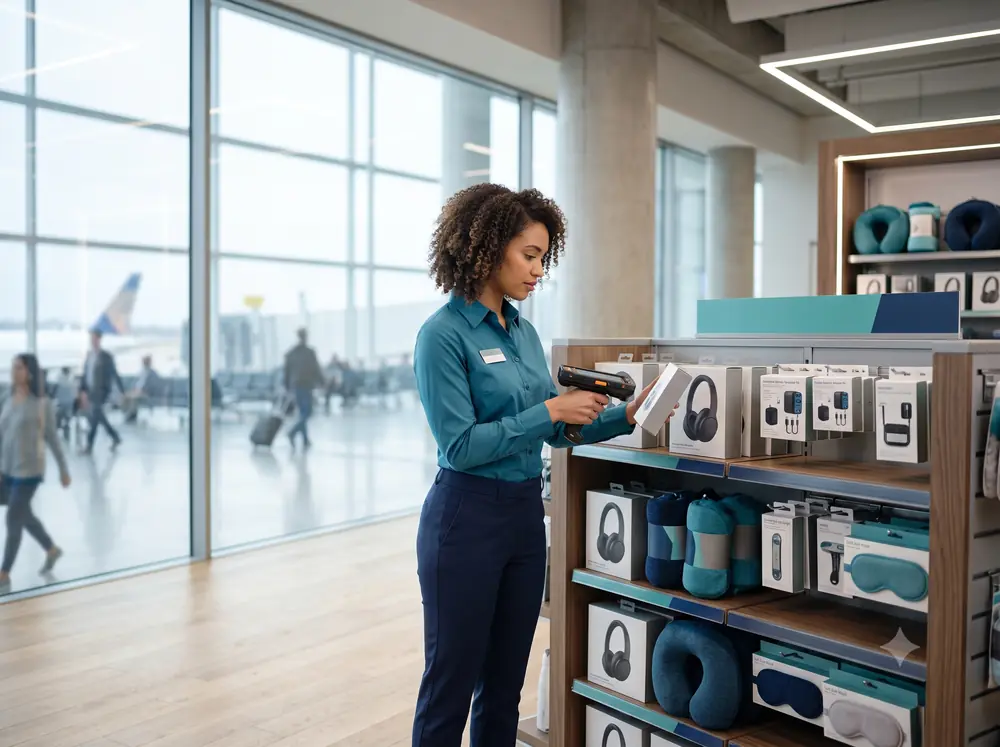
Giving Airport Store Teams Sight of Every Unit
The scenario: Three or four airport stores shared one caged storeroom, but the ERP saw each store as a single location. Receiving ran on a back-office desktop, transfers needed a scan at both stores, and cooler checks lived on paper.
What we did differently: We designed for the floor, not the back office: scan-first workflows on handhelds that work offline, a separate storeroom stock position, one-scan transfers, and QR-based cooler checks with required corrective actions.
Why Retailers Choose Innoflexion
Enterprises are not only choosing a platform; they are choosing a delivery partner. These are the standards we hold ourselves to on every engagement.
Retail & CPG Domain Expertise
Teams who have delivered OMS, ERP, and planning integrations for global brands.
Assessment Before Commitment
Data readiness scored and shared openly before you invest.
Capability Transfer by Design
We document as we build, so your teams can run it independently.
Clear Scope and Reporting
Defined milestones, regular reporting, and predictable invoicing.
Predictable, Gated Investment
A two-week assessment and a fixed-fee pilot before any rollout spend.
Delivery & Ongoing Support
A named team that plans around your peak trading seasons.
Proof Before Scale
Most retail AI projects stall between pilot and production. We tie every stage to a measurable result, and nothing scales until it has proven its return.
Readiness Assessment
We score your data, rank your highest-ROI workflows, and build a business case you can take to your board.
2 weeks · No obligationTargeted Pilot
One high-value workflow goes live in your environment, under your governance, with success metrics agreed before we start.
Fixed fee · 8–12 weeksRollout & Support
Proven solutions expand across the business, with knowledge transfer so your team owns the results.
Outcome-based pricingTrusted by Leading Brands
Works with the systems you already run
Ready to Build a Smarter Retail Operation?
Talk to our experts about where AI can make the biggest difference across your business, from buying and inventory to the store floor, and how to start without replacing the systems you already run.
Frequently Asked Questions
Do we need to replace our existing ERP or OMS to use AI?
No. Enterprise AI agents integrate directly with your existing systems of record. Connectors read from and write to systems such as SAP, Oracle, Aptos, Manhattan Associates, Shopify, and Salesforce without costly migrations. Your systems of record stay the single source of truth, so ledgers and inventory counts remain accurate.
What has Innoflexion built for retailers?
For a North America-based retail giant with 400+ airport, resort, and travel stores, we built a smart merchandising solution covering commercial planning, open-to-buy, and store-level stock availability reporting, live across 400+ stores. Its assortment planning and weekly replenishment modules are rolling out next. We also built a store operations app for handheld scanners that tracks and moves stock inside each store, from receiving to FDA temperature logs.
Will your solutions work with our ERP?
Yes. We build on the systems you already run. In our current deployment, the solutions run alongside the retailer's existing ERP, and the planning layer keeps its own product and store hierarchy, so it stays in place if the ERP changes. We scope integration with your ERP during the Readiness Assessment.
How does the merchandising solution plan replenishment across different supply routes?
The weekly replenishment module plans both warehouse delivery, where stock ships in bulk through distribution centers, and direct store delivery from vendors. For each route, it factors in vendor lead times, minimum order quantities, and order multiples.
What is open-to-buy, and how do you control it?
Open-to-buy is the amount a retailer can spend on new stock within a given time dimension without exceeding its inventory target. It equals target closing stock minus opening stock plus planned sales at cost. Our merchandising solution calculates it at any configurable product hierarchy level and time dimension from the sales plans buyers update, and blocks any plan that would create a negative open-to-buy.
Why do stores run out of stock when the business is overstocked?
Because total inventory and store-level availability are different things. When reporting stops at category level, slower stores can hold surplus units of a SKU while high-traffic stores sell out of it. Our merchandising solution measures availability for every SKU and store across any time dimension against its presentation stock, shows stock already in transit or allocated at the DC, and lets planners drill from category down to the individual store to close the gap before more stock is bought.
How do you track stock between the sales floor and the backroom?
Most ERPs treat a store as a single stock location, so they can’t show whether missing stock was lost in the backroom or on the sales floor. Our store operations app tracks inventory at location level, keeping sales floor and backroom stock separate and recording every receipt and movement with a barcode scan. Receipts, internal transfers, and spoiled or expired write-offs reach the ERP within minutes, while moves between the backroom and the shelf are tracked in the app without adding ERP transactions.
How does the store operations app support FDA food-safety inspections?
Associates scan a QR code on each cooler, freezer, or display to log opening and closing temperatures. Every reading is checked against a safe range set for that type of equipment, for example 32 to 41°F, and any out-of-range reading requires a corrective action before it can be saved. Fresh deliveries are temperature-checked on arrival, missed readings are flagged, and managers can export reports for any time dimension from the web portal when an inspector asks.
How is an AI agent different from a retail chatbot?
A chatbot answers questions; an AI agent completes work. Agents read from and write to systems such as your ERP, OMS, and WMS, and carry out multi-step workflows, for example aggregating store demand, optimizing a PO for minimum order quantities and lead times, and attaching a confidence score. Any decision outside agreed guardrails goes to a person for approval.
What do your AI agents decide on their own?
Each agent handles routine, high-volume decisions within guardrails you set, around 80% of the volume. For example, the Price Optimization Agent changes prices only within an agreed band and never below the margin floor, and the Procurement Agent places only high-confidence purchase orders. The remaining 20%, such as changes outside tolerance, new SKUs with no history, unusually large orders, or initial clearance lists, goes to your team for approval.
What is a digital twin agent in retail?
A digital twin agent mirrors a planning role, such as a replenishment planner, buyer, or pricing analyst. It reads the same data that person would use, applies the same business rules and checks, and makes routine decisions around the clock. Decisions that need judgment are routed to the person it supports, with the analysis already done.
How long does it take to deploy these solutions?
Roughly 10 to 14 weeks to a live, measured workflow. The Readiness Assessment takes about two weeks, and a targeted pilot runs 8 to 12 weeks in your environment with success metrics agreed upfront. Wider rollout is then phased around your peak trading periods.
Why do so many retail AI pilots fail to reach production?
Most stall because they start with a model instead of with data and a measurable workflow. Pilots built on data that is not ready, disconnected from systems of record, or without agreed success metrics rarely justify scaling. We score data readiness first, run one workflow live under your governance, and scale only on proven ROI.
How do AI workflows protect customer data privacy?
DeepRoot is designed with PII-aligned data controls, and governance is built into the architecture rather than left to process. It runs inside your cloud tenant or on-premises with role-based access control (RBAC). With self-hosted or private-endpoint models, customer data stays inside your perimeter and is never used to train public AI models.
