
Small Language Models vs LLMs: How to Cut Enterprise AI Inference Costs
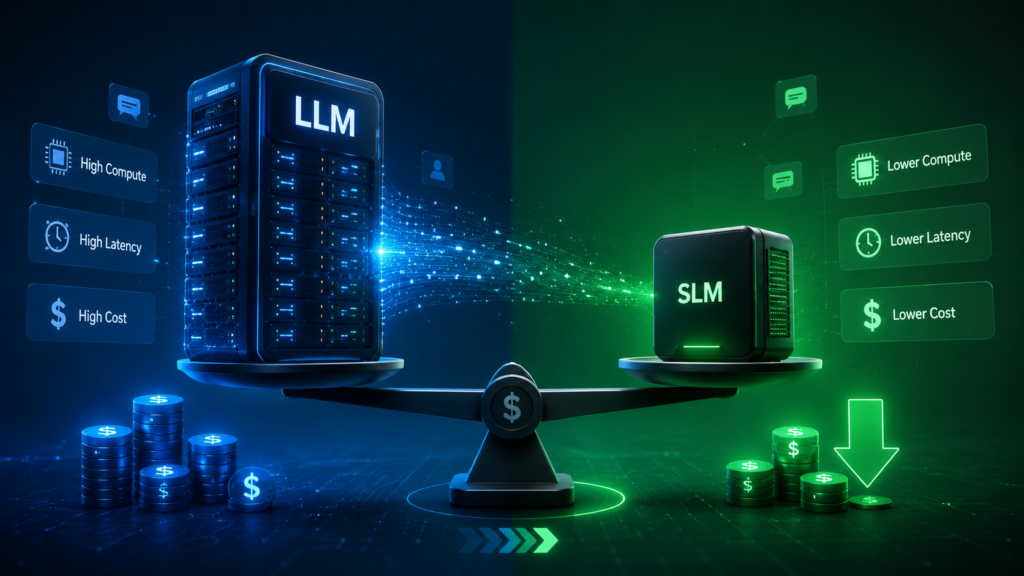
Inference prices are falling. Enterprise AI bills are rising anyway. The reason is architectural, and the fix is routing every task to the smallest model that can actually do the job.
- Serving a 7B small language model is roughly 10–30× cheaper than serving a 70–175B frontier model, for tasks where accuracy is equivalent.
- NVIDIA researchers argue SLMs are "sufficiently powerful, inherently more suitable, and necessarily more economical" for most agentic invocations.
- Gartner expects inference costs to fall over 90% by 2030, but warns enterprises won't feel it, because agentic workloads burn far more tokens per task.
- The winning pattern is not "small instead of large." It is LLM-SLM orchestration: route each step to the smallest model that provably clears your accuracy bar, with a calibrated escalation path.
- Why enterprise AI economics just inverted
- Small language models vs LLMs: the real difference
- The VRAM math behind the 10–30× cost gap
- Why falling inference prices don't help you
- The three model routing patterns
- Building a production routing layer
- Security, latency and predictable unit economics
- A seven-step adoption sequence
- Glossary of key terms
Why enterprise AI economics just inverted
For three years, the default enterprise instinct was to reach for the largest available model. It was a reasonable heuristic when capability was scarce and volumes were low. In 2026 both conditions have reversed, and the heuristic has quietly become the single largest source of avoidable AI spend on the enterprise balance sheet.
The reason is structural. Agentic systems don't make one model call, they make dozens. Consider a claims-processing agent handling a single submission: it classifies the document type, extracts twenty fields, validates each against policy rules, checks for duplicates, decides a routing path, drafts a summary for the adjuster, and writes an audit entry. That is eight or more inference calls for one claim. Under a single-model architecture, every one of them is billed at frontier-model rates, including the six that a well-tuned small model would have handled identically, and faster.
Multiply that by 40,000 claims a month and the architectural choice stops being a technical detail. It becomes a line item that finance will eventually ask about. This is the same dynamic we see across production deployments in healthcare, insurance and finance, where document-heavy workflows generate enormous call volumes against tasks that are individually simple.
This is the observation at the heart of a widely-cited 2025 paper from NVIDIA Research. In "Small Language Models are the Future of Agentic AI," Belcak and colleagues argue that SLMs are sufficiently powerful, inherently more suitable, and necessarily more economical for many invocations in agentic systems. Their position is not that large models are obsolete. It is that using one for every step of a workflow is an architectural mistake with a compounding price tag.
Small language models vs LLMs: the real difference
Parameter count alone, however, understates the difference. What changes materially is the memory footprint, the fine-tuning cost, and the deployment envelope. Here is how the two classes actually compare on the dimensions enterprises care about.
| Dimension | Small language model (1B–7B) | Frontier LLM (70B–1T+) |
|---|---|---|
| Serving cost | Baseline | ~10–30× higher for equivalent throughput |
| Memory for weights (BF16) | ~2–14 GB, single GPU | ~140 GB+, multi-GPU cluster |
| Typical latency | Sub-second | 1–5 seconds, compounding across agent steps |
| Fine-tuning cycle | Hours, single GPU with QLoRA | Days to weeks, cluster-scale |
| Deployment | On-premise, private cloud or edge | Usually hosted API or large private cluster |
| Best at | Narrow, high-volume, well-defined tasks | Open-ended reasoning, novel and ambiguous cases |
| Data sovereignty | Straightforward, data never leaves perimeter | Requires contractual and architectural controls |
The VRAM math behind the 10–30× cost gap
Inference memory scales roughly with parameters times bytes-per-parameter, plus the KV cache for context. A 7B model in BF16 needs about 14 GB of weights and fits comfortably on a single mid-tier GPU. A 70B model in the same precision needs around 140 GB, which means multiple high-end accelerators, inter-GPU communication overhead, and an entirely different class of infrastructure contract. That is the mechanical origin of the serving-cost gap, and it is why the gap does not close simply because a vendor drops its per-token price.
Training economics diverge even more sharply. Full fine-tuning of a 7B model requires on the order of 100 GB or more of VRAM once optimizer states and gradients are accounted for. Parameter-efficient methods collapse that requirement:
| Fine-tuning method | Approx. VRAM (7B model) | Practical implication |
|---|---|---|
| Full fine-tuning (all weights updated) | ~100 GB+ | Multi-GPU enterprise hardware; days per run; highest quality ceiling |
| LoRA (rank-64 adapters, BF16 base) | ~20 GB | Single high-end GPU; hours per run; ~90–95% of full fine-tuning quality |
| QLoRA (4-bit quantized base + adapters) | ~6–10 GB | Runs on a single consumer-grade GPU; fastest iteration loop |
The strategic consequence is bigger than the hardware saving. When a fine-tuning cycle takes an afternoon on one GPU instead of a week on a cluster, teams stop treating the model as a fixed input. They tune per task, per department, per document type. They close accuracy gaps by iterating rather than by escalating to a larger model. Small models are not simply cheaper to run, they are cheaper to improve, and that compounding advantage rarely shows up in a per-token comparison.
The three techniques that make small models competitive
SLMs punch above their parameter count because of three well-established compression and specialization techniques, usually applied in combination:
Knowledge distillation trains a compact "student" model to reproduce the behaviour of a larger "teacher" on a target distribution. For narrow enterprise tasks, the student frequently matches the teacher on that task while discarding the general-world capability it never needed. Quantization reduces numeric precision, typically from 16-bit to 8-bit or 4-bit, cutting memory and increasing throughput with modest and measurable quality cost. Parameter-efficient fine-tuning (LoRA, QLoRA, adapters) freezes the base weights and trains a small number of additional parameters, which is why a domain-specific variant can be produced in hours and hot-swapped without re-serving an entirely new model.
Why falling inference prices don't help you
A common objection is that inference is getting cheaper anyway, so architecture will sort itself out. The data supports the first half of that claim and firmly rejects the second.
Gartner predicts that by 2030, running inference on a one-trillion-parameter model will cost GenAI providers over 90% less than in 2025. But the same analysis carries a pointed caveat: enterprises should not expect those savings to be passed through, because demand for frontier capability, particularly agentic AI, consumes far more tokens per task than earlier generative use cases did.
The mechanism is worth stating plainly. A 2024-era chatbot exchange might consume 2,000 tokens. A 2026 agentic workflow that plans, calls tools, reflects on results, retries, and self-verifies can consume 50,000 or more for a single business transaction. If unit price falls 10× while token consumption per task rises 25×, your bill goes up.
Unit prices are falling. Token volumes are rising faster. The enterprises that win on cost in 2026 are the ones that changed their architecture, not the ones that waited for the market to change their invoice.
Gartner also reports that enterprises will use small, task-specific models roughly three times more than general-purpose LLMs by 2027. That is not a prediction about model quality. It is a prediction about where the workload sits, and it is already visible in production architectures today.
The three model routing patterns
A frontier model remains in the architecture, but as an escalation path rather than a default. There are three distinct patterns, and mature systems use all of them.
1. Predictive routing (decide upfront)
A lightweight classifier or embedding-based semantic router inspects the incoming request and dispatches it directly to a chosen model. It is fast and cheap, but commits before seeing any output. Semantic routers add roughly 50–100 ms of overhead, which sounds significant until you weigh it against a typical median inference time of around 800 ms, where it represents an acceptable single-digit-to-12% latency tax for a potentially order-of-magnitude cost reduction.
2. Cascade routing (escalate on low confidence)
Models execute sequentially from cheapest to most expensive, terminating early when a stage returns a sufficiently confident answer. The small model attempts the task; only if its confidence falls below a calibrated threshold does the request escalate. Cascades are more robust than predictive routing because the decision is made after seeing an actual attempt, at the cost of occasional double inference. In workloads where 80% of requests are routine, the arithmetic strongly favours the cascade.
3. Speculative decoding and speculative cascades (hybrid)
Here the small model acts as a drafter, proposing multiple candidate tokens that the large model verifies in bulk rather than generating one at a time. Because verification is cheaper than generation, throughput rises while output quality is preserved. Google Research's work on speculative cascades combines this with cascade logic, and published results in this family report meaningful API cost reductions alongside latency improvements versus a direct frontier-model baseline. For latency-sensitive, quality-critical paths, this is often the right answer where pure routing is too blunt.
| Task profile | Right-sized model | Why |
|---|---|---|
| Classification, routing, entity extraction, format conversion, schema validation | Fine-tuned SLM | Narrow, high-volume, low-variance. A tuned small model often beats a generalist frontier model on the specific task, at a fraction of the cost. |
| Domain summarization, structured drafting, retrieval-grounded answers | Mid-size or tuned SLM | Grounding in retrieved context does the heavy lifting; raw model scale contributes less than teams assume once RAG quality is good. |
| Open-ended reasoning, ambiguous multi-step planning, novel edge cases, adversarial input | Frontier LLM | Genuine generalization is where large-model capability earns its price. Reserve it for those calls. |
Building a production routing layer
A demo router is a switch statement. A production router is a governed subsystem. Five components separate the two.
The failure modes to design against
Routing introduces its own risks, and honest architecture accounts for them. Cascade failure occurs when a mis-calibrated small model returns confidently wrong answers, suppressing escalation precisely when it is most needed; research has shown cascaded systems can be deliberately exploited this way under adversarial input, which matters for any externally-facing agent. Router drift occurs when the traffic distribution shifts and a classifier trained on last quarter's data silently misroutes. Silent quality erosion is the most common in practice: cost falls, everyone celebrates, and nobody notices accuracy slipping two points a month because no one is running the evaluation set.
All three are governance problems as much as engineering problems, which is why orchestration belongs inside a platform with audit trails and monitoring rather than bolted on as a cost hack. The controls that matter here are the same ones that govern any enterprise AI automation programme: versioned models, human-in-the-loop checkpoints, and a complete record of every decision.
Security, latency and predictable unit economics
Cost is the headline, but for regulated enterprises it is often not the deciding factor.
Data sovereignty and deployment control
A model small enough to run on your own infrastructure is a model whose inputs never leave your perimeter. For healthcare, financial services, and public-sector workloads, that transforms a difficult compliance conversation into a straightforward one. SLMs make on-premise and edge deployment economically realistic rather than a theoretical option, supporting HIPAA, SOC 2, GDPR and data-residency obligations without architectural contortion. It also enables local adaptation to regional compliance rules and language requirements, a point the NVIDIA researchers highlight explicitly.
Latency and compounding user experience
Smaller models respond faster, and in an agent that chains six inferences, latency compounds. Six steps at 2.5 seconds is a fifteen-second wait; six steps at 400 ms feels instantaneous. For real-time customer-facing agents this is frequently a harder constraint than cost, and it is one that no amount of price reduction on a large model will fix.
Predictable unit economics
Self-hosted small models convert a variable, volume-linked API bill into a largely fixed infrastructure cost. For finance teams forecasting AI spend across a scaling deployment, that predictability changes how the programme gets funded, and often whether it gets approved at all.
A seven-step adoption sequence
- 1. Instrument before optimizing: log every model call with task type, token count, latency and cost. The 20% of tasks driving 80% of spend are almost always narrow and repetitive.
- 2. Pick one high-volume task: document classification and field extraction are the usual best first candidates, high frequency and easy to label.
- 3. Build the evaluation set first: a few hundred well-labelled examples, versioned like code. Without it you cannot make a promotion decision defensibly.
- 4. Fine-tune with QLoRA and shadow-run: run the SLM in parallel against the incumbent model on live traffic, comparing outputs without acting on them.
- 5. Promote on evidence, calibrate thresholds: switch over only when the small model meets your agreed accuracy bar, then tune the escalation threshold against real outcomes.
- 6. Keep the escalation path permanently: low-confidence and out-of-distribution cases route up to the frontier model, always.
- 7. Re-measure continuously: data drifts, routers decay, and routing decisions must be re-validated, never set once.
Why this is a data problem before it is a model problem
Here is the part most cost-optimization discussions skip. You cannot route intelligently across a workload you haven't characterized, and you cannot fine-tune a small model on data that is fragmented, unlabelled, or ungoverned. Every step above assumes you know what your tasks are, where your data lives, and whether it is fit for training and grounding.
That assumption is where most orchestration initiatives stall. Distillation needs a clean teacher-output corpus. QLoRA needs labelled task data. A semantic router needs representative traffic. An evaluation harness needs ground truth. Each of those is a data-readiness requirement wearing an engineering costume, and an organization that cannot produce them will not capture the 10–30× advantage no matter which models it selects. This is exactly why we treat enterprise data engineering as the foundation of any AI cost programme rather than a parallel workstream.
Turning the architecture into an outcome
Model routing is straightforward to describe and demanding to operate. It requires connectors into fragmented enterprise systems, calibrated confidence thresholds, an evaluation harness running continuously in production, governance and audit trails across every model call, and a deployment environment that keeps sensitive data inside your perimeter. Building that foundation from scratch typically consumes the first two or three quarters of an enterprise AI programme, before a single business outcome lands.
This is precisely the gap Innoflexion was built to close. Our DeepRoot platform provides intelligent LLM-SLM orchestration as a native capability rather than a custom build: model-agnostic routing across public and private models, an Agentic Workbench for composing and governing multi-agent workflows with end-to-end audit logging, and a secure walled-garden environment so small models run on-premise or in your private cloud with no data leaving your control.
Critically, DeepRoot starts where the economics actually start, with your data. Its proprietary Data Readiness Index scores enterprise data across seven dimensions and 50+ enterprise AI metrics, so you know which workflows are ready to be routed to a small model and which need remediation first, before you commit budget. Paired with two decades of product engineering depth and pre-built connectors into systems like Salesforce, SharePoint, Snowflake and Oracle, that combination is why Innoflexion clients typically see a working proof of concept in four to eight weeks and production rollout in three to six months, with full audit trails and no vendor lock-in.
The enterprises pulling ahead in 2026 aren't the ones running the biggest models. They're the ones who worked out, with evidence, exactly which calls needed a big model at all.
Find out what your AI workload should actually cost
Start with a complimentary AI Readiness Assessment: your data scored across seven dimensions, your three highest-ROI use cases identified, and a 30-day roadmap to production, at no cost and no obligation.
Glossary of key terms
- Small language model (SLM)
- A language model under roughly 10 billion parameters, compact enough to run on commodity hardware with low latency. Enterprise sweet spot: 1B–7B.
- LLM-SLM orchestration
- Routing each task in an AI workflow to the smallest model that can complete it correctly, with a frontier model reserved as an escalation path.
- Predictive routing
- Classifying a request upfront and dispatching it directly to a chosen model, before any output is generated.
- Cascade routing
- Running models sequentially from cheapest to most expensive, stopping early when a stage returns a sufficiently confident answer.
- Speculative decoding
- Using a small "drafter" model to propose candidate tokens that a larger model verifies in bulk, raising throughput while preserving output quality.
- LoRA / QLoRA
- Parameter-efficient fine-tuning methods that freeze base model weights and train small adapter layers. QLoRA adds 4-bit quantization, reducing 7B fine-tuning to roughly 6–10 GB of VRAM.
- Knowledge distillation
- Training a compact student model to reproduce a larger teacher model's behaviour on a target task distribution.
- Quantization
- Reducing the numeric precision of model weights (16-bit to 8-bit or 4-bit) to cut memory footprint and increase inference throughput.
- Data Readiness Index (DRI)
- Innoflexion's proprietary scoring framework that evaluates enterprise data across seven dimensions and 50+ enterprise AI metrics to determine AI readiness before deployment.
Frequently asked questions
What is the difference between a small language model and a large language model?
A small language model (SLM) is compact enough to run on commodity hardware while still delivering low-latency responses, typically under roughly 10 billion parameters, with an enterprise sweet spot of 1B to 7B. A large language model (LLM) or frontier model typically ranges from 70 billion to over a trillion parameters and offers stronger general reasoning. The practical difference is economic: a 7B model needs about 14 GB of memory for weights, while a 70B model needs about 140 GB, which is why serving an SLM is commonly cited as 10 to 30 times cheaper for tasks where accuracy is equivalent.
How can enterprises reduce AI inference costs?
The highest-leverage method is model routing: dispatching each task to the smallest model that provably clears the accuracy threshold, rather than sending every request to a frontier model. Enterprises typically combine four techniques: fine-tuning small models on narrow high-volume tasks, cascade routing that escalates only low-confidence requests, quantization to reduce memory footprint, and self-hosting small models to convert variable API spend into fixed infrastructure cost. Instrumenting existing traffic to find the 20% of tasks driving 80% of spend is the necessary first step.
What is LLM-SLM orchestration?
LLM-SLM orchestration is an architectural pattern in which an enterprise AI system routes each task to the smallest model capable of handling it correctly. High-frequency, narrow, well-defined steps such as classification, extraction, routing and format conversion are served by fine-tuned small language models, while genuinely open-ended reasoning escalates to a large frontier model. A routing layer, evaluation harness and confidence-based fallback path govern the decision, so cost falls without accuracy loss.
How much cheaper are small language models than large LLMs?
Serving a 7-billion parameter small language model is commonly cited as 10 to 30 times cheaper than serving a 70 to 175-billion parameter frontier model, because the smaller model needs far less GPU memory and compute per token. The gap widens further in training: full fine-tuning of a 7B model can require 100 GB or more of VRAM, while QLoRA fine-tuning of the same model fits in roughly 6 to 10 GB, allowing it to run on a single consumer-grade GPU.
What is cascade routing in LLM orchestration?
Cascade routing executes models sequentially from cheapest to most expensive, terminating early when a stage returns a sufficiently confident answer. A small model attempts the task first; only when its confidence falls below a calibrated threshold does the request escalate to a larger model. This avoids paying frontier-model prices for the majority of requests while preserving a quality ceiling for hard cases. It differs from predictive routing, which classifies the request upfront and dispatches it directly to a chosen model.
Will falling inference prices make SLM orchestration unnecessary?
No. Gartner predicts that by 2030 the cost of inference on a one-trillion-parameter model will fall over 90% compared with 2025, but also cautions that enterprises are unlikely to see a proportional saving, because agentic workloads consume far more tokens per task than earlier generative AI use cases. Falling unit prices are being outrun by rising token volumes, which makes routing architecture more important, not less.
Are small language models secure enough for regulated industries?
Small language models are often more suitable for regulated industries than frontier models, because they are compact enough to run on-premise or in a private cloud, meaning sensitive data never leaves the enterprise perimeter. This supports HIPAA, SOC 2, GDPR and data-residency obligations directly, and allows local adaptation to regional compliance rules. Security still depends on surrounding controls: role-based access, audit logging of every model call, human-in-the-loop checkpoints on high-stakes decisions, and continuous accuracy monitoring.
- Escaping Pilot Purgatory: The AI Data Readiness Index (DRI)
- Generative AI vs Agentic AI: What Enterprises Must Know in 2026
- Enterprise AI Reality Check: Bridging the Execution Gap
- The DeepRoot Platform: DRI, AI Compass, Agentic Workbench & D.A.V.E.
- Case studies: production GenAI across healthcare, insurance, retail and energy
Sources & further reading
- Belcak, P., et al. "Small Language Models are the Future of Agentic AI." NVIDIA Research, arXiv:2506.02153, 2025. arxiv.org
- Gartner. "Gartner Predicts That by 2030, Performing Inference on an LLM With 1 Trillion Parameters Will Cost GenAI Providers Over 90% Less Than in 2025." March 25, 2026. gartner.com
- Gartner. "Gartner Predicts 40% of Enterprise Apps Will Feature Task-Specific AI Agents by 2026." August 26, 2025. gartner.com
- Google Research. "Speculative Cascades: A Hybrid Approach for Smarter, Faster LLM Inference." research.google
- Hu, E., et al. "LoRA: Low-Rank Adaptation of Large Language Models." arXiv:2106.09685. arxiv.org
- Dettmers, T., et al. "QLoRA: Efficient Finetuning of Quantized LLMs." arXiv:2305.14314. arxiv.org
- NIST. "AI Risk Management Framework (AI RMF 1.0)." nist.gov