
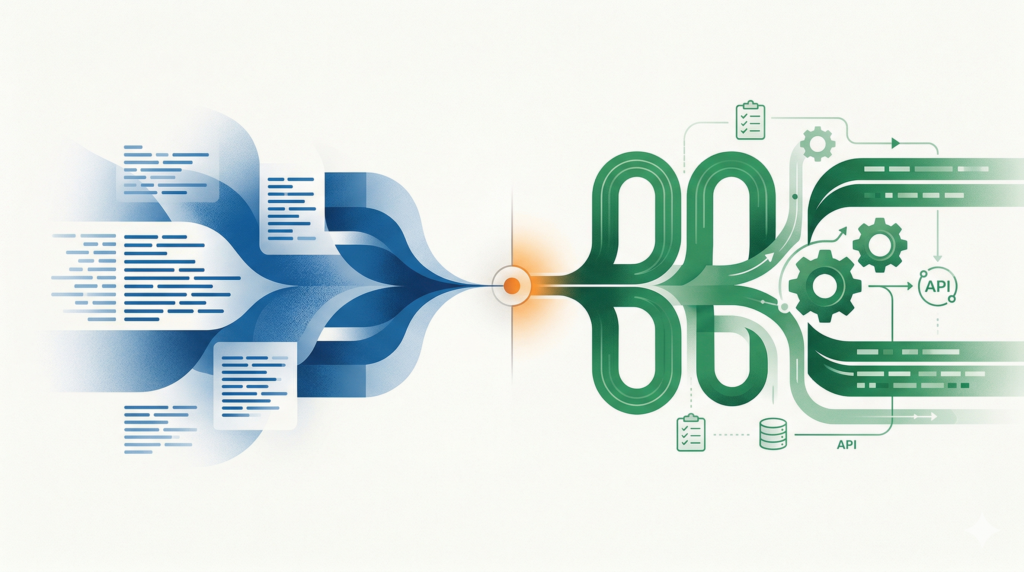
Agentic AI vs Generative AI: What Enterprise Leaders Must Know in 2026
Every boardroom is asking the same question right now: we've deployed generative AI — now what? The answer is agentic AI. But the distinction between the two isn't just technical. It defines your entire enterprise AI strategy, your ROI expectations, and how ready your data infrastructure needs to be before you build anything.
→ Check your data architecture scoreTwo years ago, the enterprise AI conversation was dominated by one question: how do we use ChatGPT? Teams deployed generative AI for writing, summarisation, code generation, and customer-facing chatbots. Productivity went up. Boards were impressed. Slides were made.
Then the ROI conversations started. And the same pattern emerged everywhere: generative AI helped individuals work faster, but it rarely moved the needle at the operational level. Entire business processes — invoice approvals, claims triage, compliance reviews, supply chain decisions — remained largely untouched.
That gap is exactly what agentic AI is designed to close. But to deploy it effectively, enterprise leaders need to understand not just what agentic AI is, but how it differs from generative AI in ways that have profound implications for data infrastructure, governance, and deployment strategy.
The Fundamental Distinction: Creation vs. Action
The simplest way to understand the difference between generative AI and agentic AI is this: generative AI creates output; agentic AI creates outcomes.
Generative AI is reactive. You give it a prompt, it produces a response — a document, a summary, a piece of code — and its job is done. Every interaction begins and ends with that prompt-response cycle. The model has no persistent goals, no awareness of what happened before the prompt or after, and no ability to take action in the world beyond generating text.
Agentic AI is proactive. You give it a goal — not a prompt, a goal — and it figures out the steps required to achieve that goal. It plans. It calls APIs. It queries databases. It passes results to other agents. It evaluates whether what it did worked and adjusts accordingly. It keeps going until the goal is achieved, or until a human needs to make a decision it cannot make alone.
Reactive Content Creator
- Responds to a single prompt at a time
- Produces text, images, code, or summaries
- No persistent memory across interactions
- No ability to act on external systems
- Requires human to take next action
- Output quality depends on prompt quality
- Single inference cycle per response
Proactive Autonomous Executor
- Pursues goals across multi-step workflows
- Plans, decides, acts, and iterates
- Maintains context and memory over time
- Interacts with APIs, databases, and systems
- Executes actions without human prompting
- Evaluates outcomes and self-corrects
- Runs repeated inference loops to goal completion
A concrete illustration: Ask a generative AI "write a follow-up email to our overdue invoice clients" — and it produces a well-written email template. Give an agentic AI the goal "resolve all invoices overdue by 30+ days" — and it queries your ERP, identifies the accounts, drafts personalised emails per client, sends them via your email API, logs the actions in your CRM, monitors for replies, and escalates unresponsive accounts to your collections team. Same starting point. Radically different scope of impact.
A Side-by-Side Comparison for Enterprise Decision-Makers
| Dimension | Generative AI | Agentic AI |
|---|---|---|
| Core function | Create content from prompts | Execute goals across systems |
| Mode of operation | Reactive — waits for input | Proactive — pursues objectives |
| Decision-making | None — outputs only | Autonomous, goal-directed |
| Memory & context | Stateless per session | Persistent across interactions |
| System integration | Minimal — text in, text out | Deep — APIs, DBs, workflows |
| Human oversight needed | Every action requires human | Only at defined checkpoints |
| Data quality requirement | Moderate — affects output quality | High — errors trigger real actions |
| Implementation complexity | Lower — API access sufficient | Higher — requires orchestration layer |
| Best metric | Output quality / user adoption | Process automation rate / ROI |
| Enterprise maturity fit | Early to intermediate stages | Intermediate to advanced stages |
Where Each Technology Delivers in the Enterprise
Neither generative AI nor agentic AI is universally superior — they are suited to different categories of enterprise problem. Understanding where each type excels allows organisations to build an AI portfolio that captures value at every layer of operations.
Where Generative AI Excels
Generative AI is the right tool when the goal is accelerating individual cognitive tasks: drafting, summarising, translating, coding, classifying, and explaining. It augments the work of individual contributors and knowledge workers — helping them do more of the same work faster and at higher quality.
Campaign Content at Scale
Generate 20 email variants, adapt tone by segment, produce localised versions — all in minutes rather than days.
10x Content VelocityCode Generation & Review
Assist developers with boilerplate, debug suggestions, documentation drafts, and unit test generation.
30–40% Dev EfficiencyContract Summarisation
Distil 50-page contracts into structured summaries highlighting key obligations and risk clauses.
75% Faster ReviewResponse Drafting
Generate first-draft responses to support tickets, which agents review and send — compressing handle time significantly.
50% Handle Time ReductionWhere Agentic AI Excels
Agentic AI is the right tool when the goal is automating entire operational processes — not speeding up individual tasks, but eliminating the need for human coordination across multi-step workflows that span systems, time, and decisions.
End-to-End Invoice Processing
Agent ingests invoices, extracts data, matches to POs, routes for approval, posts to ERP, and flags exceptions — autonomously.
60% Faster ProcessingClaims Triage & Classification
Agents classify claim type, extract relevant codes, cross-reference policy rules, and route to the correct processing queue without manual review.
95% Automation AccuracyProactive Account Monitoring
Agent monitors usage signals, identifies churn risk, drafts personalised outreach, schedules follow-ups, and escalates to the CSM at the right moment.
3x Retention SignalsAcademic Advising Workflows
Agents track student progress, flag academic risk, draft advisor communications, and coordinate between departments to resolve blockers.
60% Admin Time SavedIs your data ready for agentic AI deployment?
Agentic AI demands higher data quality than generative AI. DeepRoot's DRI audit scores your readiness across 7 dimensions in 2 weeks.
The Critical Enterprise Nuance: Agentic AI Raises the Data Quality Bar
This is the point most enterprise AI strategies miss. When generative AI produces a bad output, a human reads it, recognises the error, and doesn't send it. The damage is contained. When agentic AI executes a bad decision, that decision is acted upon — potentially triggering a transaction, a communication, a database update, or a compliance record that cannot be easily undone.
The key risk difference: In generative AI, poor data quality produces a bad draft. In agentic AI, poor data quality can produce a wrong action at scale. This is why data readiness — assessed quantitatively before deployment — is not optional for agentic AI; it is a hard prerequisite.
Gartner warning (June 2025): Over 40% of agentic AI projects will be cancelled by end of 2027 due to escalating costs, unclear business value, or inadequate risk controls. The firm found most current projects are hype-driven proof-of-concepts that stall before production — precisely because data and governance foundations were never validated upfront.
Consider an agentic invoicing workflow that processes 2,400 invoices per month at 95% automation accuracy. At that scale, 5% error means 120 invoices per month processed incorrectly — generating duplicate payments, missed obligations, or compliance exposures. Every additional percentage point of data quality improvement translates directly to reduced financial risk.
This is precisely why DeepRoot's architecture sequence begins with the Data Readiness Index before any agent deployment. The DRI identifies which data sources are clean enough to act on autonomously, which require human review checkpoints, and which need remediation before any agent should be trusted to touch them.
"Enterprises in 2026 aren't interested in AI assistants. They want autonomous execution. Agentic AI delivers that — but only if the data underneath it is ready."
DeepRoot AI Research, 2026How to Decide What Your Enterprise Needs Right Now
The right question isn't "should we use generative AI or agentic AI?" Most mature enterprise AI strategies will use both — generative AI as a content and reasoning component within larger agentic workflows. The question is where to start and in what sequence.
Quick Decision Framework: GenAI vs Agentic AI
How DeepRoot Brings Both Together
DeepRoot's platform is designed around the reality that enterprise AI in 2026 requires both generative and agentic capabilities — coordinated across your actual data infrastructure, not demonstrated in a sandbox. The architecture has four integrated layers that reflect this:
Data Readiness Index (DRI) — Before any AI deployment, DRI scores your enterprise data across seven dimensions to identify what is ready to act on autonomously, what needs human oversight, and what needs remediation. This is your foundation.
D.A.V.E. (DeepRoot AI Virtual Expert) — The conversational layer that combines generative AI's natural language capability with agentic AI's system awareness. DAVE doesn't just answer questions — it understands your organisation's structure and can initiate workflows, surface bottlenecks, and coordinate agent actions from a single interface.
Agentic AI Orchestration — Modular, domain-specific agents that execute multi-step business processes — from document classification and smart form handling to invoice processing, claims triage, and compliance review — all operating within your governance framework.
AI Compass — The discovery engine that scans your data to identify which GenAI and agentic use cases your data can actually support right now, prioritised by feasibility and ROI potential. This prevents the common mistake of over-ambitious first deployments on under-ready data.
D.A.V.E. — Where GenAI Meets Agentic Intelligence
D.A.V.E. (DeepRoot AI Virtual Expert) is the bridge between generative AI's conversational power and agentic AI's autonomous execution — context-aware, system-integrated, and built on your data.
Org-Aware Reasoning
Understands your structure, roles, and workflows — not just general knowledge
Multi-System Querying
Retrieves insights from CRMs, file systems, databases, and email simultaneously
Agent Coordination
Triggers and monitors specialised agents to automate follow-up workflows
Governance-First
Every action governed by RBAC, data masking, and full audit logging
Deploy your first agentic workflow in 2–4 weeks · No data movement required
The Bottom Line for 2026
Generative AI gave enterprises a productivity tool. Agentic AI gives enterprises an operational capability. The difference is not incremental — it is categorical. Generative AI helps your people work better. Agentic AI changes what your organisation can do without people in the loop at every step.
But agentic AI also demands more from your data infrastructure than generative AI ever did. The mistakes it can make are consequential. The governance it requires is non-trivial. The data quality it depends on must be scored, not assumed.
The enterprises that will lead in agentic AI through 2026 and beyond are not necessarily those with the biggest AI budgets or the most sophisticated models. They are the organisations that took data readiness seriously before they started building — and built on a foundation solid enough to trust an agent to act on their behalf.
Ready to Move from GenAI to Agentic AI?
Start with a data readiness score. Know exactly which workflows your data can support autonomously today — before you build anything.
Deployed across Healthcare · Finance · Education · Manufacturing
Agentic AI vs Generative AI: Common Enterprise Questions
What is the difference between agentic AI and generative AI? +
Generative AI is reactive — it creates content (text, images, code) in response to a user prompt and stops there. Agentic AI is proactive — it sets goals, plans multi-step actions, interacts with external systems and APIs, evaluates outcomes, and adapts without requiring continuous human input. In enterprise terms: generative AI helps your team produce faster; agentic AI helps your organisation perform autonomously.
What is agentic AI in an enterprise context? +
Enterprise agentic AI refers to AI systems deployed within an organisation that can autonomously execute multi-step business processes — such as invoice processing, claims triage, customer support resolution, or supply chain reordering — by reasoning across data sources, calling APIs, making decisions, and adapting based on results, all without step-by-step human instruction.
When should I use agentic AI vs generative AI? +
Use generative AI when the goal is accelerating content production, drafting, summarisation, code generation, or knowledge retrieval by individual users. Use agentic AI when the goal is automating end-to-end business processes — multi-step workflows that span systems, require decisions, or need to run without constant human oversight. Most mature enterprise AI strategies use both: generative AI as a component within larger agentic workflows.
How widely adopted is agentic AI in enterprises in 2026? +
Adoption is accelerating rapidly. BCG's IT Spending Pulse survey (April 2025) found 58% of companies have already integrated AI agents into operations, with another 35% actively exploring them. Gartner predicts that by 2028, 33% of all enterprise software applications will include agentic AI capabilities — up from less than 1% in 2024. BCG's October 2025 update puts expected returns from AI agents at 14.7%, outpacing all other GenAI investment categories.
What is DAVE and how does it relate to agentic AI? +
DAVE (DeepRoot AI Virtual Expert) is DeepRoot's agentic AI interface that combines conversational intelligence with autonomous action. Unlike a standard generative AI chatbot that only answers questions, DAVE understands your organisation's structure, roles, and data — and can collaborate with specialised agents to automate workflows, surface bottlenecks, and initiate multi-system actions from a single natural language prompt.
Does agentic AI require better data than generative AI? +
Yes — significantly so. Because agentic AI makes autonomous decisions and executes actions across real systems, the data it reasons over must be accurate, current, governed, and semantically coherent. Poor data quality in a generative AI system produces a bad draft. Poor data quality in an agentic system can trigger incorrect transactions, missed approvals, or compliance violations at scale. Data readiness — scored via DeepRoot's DRI — is an essential prerequisite before deploying enterprise agentic AI.