
How Much Does It Cost to Build an Enterprise AI Agent?
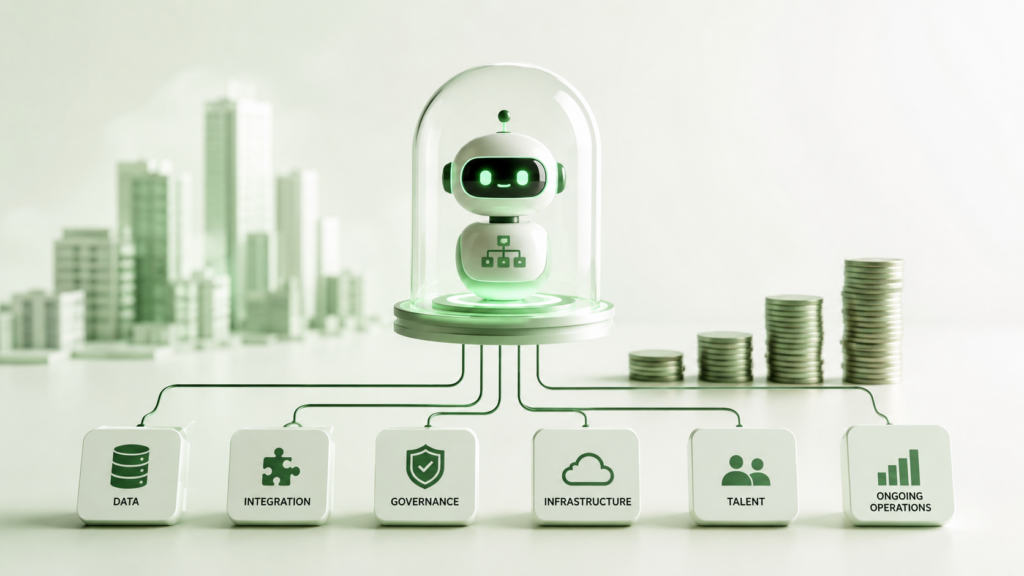
Ask five vendors and you'll get five numbers an order of magnitude apart. That's not evasion — it's because the model is the cheapest part. The real cost is in the data, the integration and the governance, and most budgets underestimate all three.
- The model is rarely the main cost. For most enterprise agents, data readiness, integration and governance dominate the budget — often 60–80% of total cost.
- A single-workflow proof of concept typically runs weeks at a contained fixed fee; a production rollout runs months and costs materially more, because production means integration, governance and change management, not just a working demo.
- Build-from-scratch carries a large hidden cost: teams routinely spend the first two to three quarters on foundational plumbing before a single business outcome lands.
- Platform-led delivery compresses that foundation, taking enterprises to a working POC in 4–8 weeks and production in 3–6 months.
- The number that matters is not build cost but cost-to-outcome: what you spend to reach a measurable, governed result on real data. IDC puts the average GenAI return at $3.70 per $1 — but only for firms that did the groundwork.
- Why "what does an AI agent cost" has no single answer
- The five real cost components
- Build vs buy: the honest trade-off
- POC vs production: two very different price tags
- The run-cost trap: why inference bills climb
- The hidden cost almost every budget misses
- How to budget realistically
- Glossary of key terms
Why "what does an AI agent cost" has no single answer
The honest answer to "how much does it cost to build an enterprise AI agent?" is it depends far more on your data and your systems than on the agent itself. That sounds like a dodge, but it's the single most important thing to understand before setting a budget.
A demo agent that answers questions over a clean dataset can be stood up in days by one engineer. An agent that autonomously processes claims, reconciles invoices or resolves disputes across live enterprise systems — with the governance a regulated business requires — is a different class of undertaking. Same word, "agent." Costs that differ by two orders of magnitude. The variable that explains the gap is almost never the model; it's the readiness of everything around it. That is also why so many of these projects fail on budget: Gartner expects over 40% of agentic AI projects to be cancelled by the end of 2027, citing escalating costs and unclear value first.
The five real cost components
An enterprise AI agent's total cost of ownership breaks into five parts. Budgets that only count the first one are the budgets that overrun.
| Component | What it covers | Typical share of TCO |
|---|---|---|
| Model & inference | LLM/SLM access or hosting, tokens, GPUs | Often the smallest line, 10–25% |
| Data readiness | Cataloguing, cleaning, labelling, governing the data the agent reasons over | Large and routinely underestimated |
| Integration | Connectors into CRMs, ERPs, document stores, databases; API handoffs | Large |
| Engineering & orchestration | Routing, evaluation harness, retries, guardrails, agent logic | Significant |
| Governance & run | Audit trails, monitoring, human-in-the-loop, drift re-validation, ongoing ops | Recurring, forever |
The pattern to internalise: the model is a small, shrinking share of the cost; the data and governance are large, recurring shares. Inference prices keep falling, but the cost of making your data fit to act on, and of proving an autonomous system is behaving, does not fall with them.
Build vs buy: the honest trade-off
There are three routes to an enterprise agent, and each has a distinct cost shape.
| Route | Upfront cost | Time to first outcome | Best when |
|---|---|---|---|
| Build from scratch | Highest; you fund all foundational plumbing | Slowest — often 2–3 quarters before value | You have a deep AI engineering bench and a truly novel need |
| Assemble open-source | Moderate; lower licence cost, high integration cost | Medium; you still build orchestration & governance | Strong engineering team, tolerance for maintenance burden |
| Platform-led delivery | Predictable; you pay for a prebuilt foundation | Fastest — POC in weeks | You want measured outcomes on your data quickly, with governance included |
Build-from-scratch is where hidden cost hides. Teams underestimate the foundational work — connectors into fragmented systems, a routing layer, confidence calibration, an evaluation harness running continuously in production, audit trails across every model call, and a deployment environment that keeps sensitive data inside the perimeter. Building that from zero typically consumes the first two or three quarters of an enterprise AI programme, before a single business outcome lands. That's not a licence fee, but it is very real money — and it's the line most build-vs-buy comparisons omit.
Platform-led delivery trades some bespoke flexibility for the elimination of that foundational quarter-count. Innoflexion's DeepRoot platform, for example, provides orchestration, connectors, an agentic workbench and a secure walled-garden environment as native capabilities, which is why clients typically reach a working POC in four to eight weeks rather than spending two quarters on plumbing. We go deeper on this decision in Agentic AI Development: Build vs. Buy and Choosing a Partner.
POC vs production: two very different price tags
Conflating these two is the most common budgeting error. They are different products with different costs.
A production rollout is where the cost lives, because production is not a bigger demo. It adds integration into live systems, hardening for concurrency and edge cases, change management, monitoring, and governance — the difference between "it worked in a controlled test" and "it runs reliably against messy real data under load." This is why production is priced per engagement (time-and-materials or outcome-based) rather than as a flat fee.
| Proof of concept | Production rollout | |
|---|---|---|
| Scope | One bounded use case | Live, integrated, hardened |
| Duration | ~4–8 weeks | ~3–6 months |
| Pricing shape | Fixed fee | T&M or outcome-based |
| Ends in | Go/no-go decision | Governed, monitored deployment |
| Main cost driver | The single workflow | Integration + governance + change |
The run-cost trap: why inference bills climb
Even after build, agents cost money to run — and that bill behaves counterintuitively. Agentic systems don't make one model call per task; they make dozens. A single claims submission might be classified, have twenty fields extracted, validated against rules, checked for duplicates, routed, summarised and logged — eight or more inference calls for one transaction.
That's why falling per-token prices don't automatically shrink your bill. Gartner projects inference on a trillion-parameter model will cost over 90% less by 2030 than in 2025 — but warns enterprises won't feel it, because agentic workloads burn far more tokens per task. If unit price falls while token volume per task rises faster, the invoice goes up.
Unit prices are falling. Token volumes are rising faster. The enterprises that win on cost are the ones that changed their architecture, not the ones that waited for the market to change their invoice.
The fix is architectural: route each step to the smallest model that can do it correctly, reserving a frontier model for genuinely open-ended cases. Done well, this LLM-SLM orchestration cuts run cost substantially without losing accuracy — the full mechanics are in Small Language Models vs LLMs: How to Cut Enterprise AI Inference Costs, and the underlying research is set out by NVIDIA Research. Budget for run cost as an ongoing line, and design the architecture to control it — don't assume market price drops will do it for you.
The hidden cost almost every budget misses: data readiness
Here is the cost that sinks projects. You cannot build a reliable agent on data that is fragmented, unlabelled or ungoverned — and most enterprise data is at least one of those. Research from Deloitte has repeatedly found that a majority of organisations consider their data not yet fully AI-ready, and ungoverned, low-quality data is consistently identified as a leading cause of failed AI initiatives.
The consequence is blunt: money spent building an agent on unready data is money spent building on sand. This is a large part of why Gartner expects over 40% of agentic AI projects to be cancelled by the end of 2027. The root cause is rarely the model — it's that the data underneath was never fit to act on. Independent surveys reinforce the point from the ROI side: while IDC's Microsoft-sponsored study reports an average $3.70 return per $1 invested in generative AI, McKinsey's State of AI finds only a minority of firms attribute meaningful EBIT impact to AI so far. The returns are real, but concentrated among organisations that did the data groundwork first.
The way to de-risk the budget is to measure data readiness before committing build spend. Innoflexion's Data Readiness Index (DRI) scores enterprise data across seven dimensions and 50+ metrics, so you learn — before you spend — which workflows are ready, which need a human checkpoint, and which require remediation first. A DRI turns "how much will this cost?" from a guess into a scoped estimate.
How to budget realistically
- 1. Don't price a build before you've scored the data. Run a readiness assessment on the one workflow you care about most. The DRI converts unknowns into a scope.
- 2. Budget the POC and production separately. Treat the POC as a contained, fixed-fee decision gate. Only size the production budget after the POC proves value on your data.
- 3. Assume the model is the smallest line. Allocate the bulk of the budget to data readiness, integration and governance — the components that actually determine success.
- 4. Fund governance as a recurring cost, not a one-off. Audit trails, monitoring, drift re-validation and human-in-the-loop review continue for the life of the agent.
- 5. Design run cost down from day one. Plan for LLM-SLM orchestration so inference cost stays predictable as volume scales.
- 6. Measure cost-to-outcome, not cost-to-build. The meaningful figure is what you spend to reach a measured, governed business result — and whether that result recurs.
Framed this way, the right question isn't "what does an AI agent cost?" It's "what does it cost to reach a governed outcome on my data?" — and that's a question a readiness assessment can actually answer.
Why Innoflexion is the partner that protects your budget
Most cost overruns don't come from a vendor charging too much per day. They come from a programme that spent two quarters building foundations, discovered mid-flight that the underlying data couldn't support the use case, and had no measured checkpoint at which to stop. The way to protect a budget is to remove those two failure modes — and that is exactly how Innoflexion is structured to work.
The DeepRoot platform supplies the expensive foundation — LLM-SLM orchestration, prebuilt connectors into systems like Salesforce, SharePoint, Snowflake and Oracle, an agentic workbench, and a secure walled-garden environment — as native capability, so you don't pay to rebuild plumbing that already exists. And every engagement starts with the Data Readiness Index, scoring your data across seven dimensions and 50+ metrics before a line of the agent is built, so you commit budget against evidence rather than optimism. That combination, backed by two decades of product engineering depth, is why clients typically reach a working proof of concept in four to eight weeks and production in three to six months — with a clear go/no-go gate in between, full audit trails, and no vendor lock-in.
The enterprises that get real returns on AI aren't the ones that spent the most. They're the ones who found out what their data could support before they wrote the cheque — and only scaled what proved its value.
Get a scoped estimate, not a guess
Start with a complimentary AI Readiness Assessment: your data scored across seven dimensions, your three highest-ROI use cases identified, and a 30-day roadmap to production — so you can budget from evidence, not vendor hand-waving.
Glossary of key terms
- Enterprise AI agent
- An AI system that autonomously executes multi-step workflows across enterprise systems — classifying, deciding and acting — rather than only generating text for a human to review.
- Total cost of ownership (TCO)
- The full cost of an agent across its life: build, integration, run/inference, and ongoing governance and monitoring.
- Proof of concept (POC)
- A bounded, fixed-scope build on one use case that ends in a measured go/no-go decision.
- LLM-SLM orchestration
- Routing each task to the smallest model that can handle it correctly, reserving a frontier model for open-ended cases, to control run cost without losing accuracy.
- Data Readiness Index (DRI)
- Innoflexion's DeepRoot DRI framework scoring enterprise data across seven dimensions and 50+ metrics to determine AI readiness — and therefore cost and feasibility — before deployment.
- Walled-garden deployment
- Running the agent inside your own perimeter (on-premise or private cloud) so sensitive data never leaves your control.
Frequently asked questions
How much does it cost to build an enterprise AI agent?
There is no single figure, because the model is usually the smallest cost. For most enterprise agents, data readiness, integration into live systems, and governance dominate the budget — commonly 60–80% of total cost. A bounded proof of concept on one workflow can be a contained fixed fee delivered in weeks, while a production rollout runs over months and costs materially more. The honest way to get a real number is to score your data readiness first, which converts the unknowns into a scoped estimate.
Why is building an AI agent more expensive than it looks?
Because production is not a bigger demo. A working demo hides the real costs: connectors into fragmented systems, a routing and orchestration layer, an evaluation harness running continuously, audit trails across every model call, human-in-the-loop review, and a secure deployment environment. Teams building from scratch often spend the first two to three quarters on this foundation before any business outcome lands — cost that most build-vs-buy comparisons leave out.
Is it cheaper to build or buy an enterprise AI agent?
It depends on your engineering bench and how novel your need is. Building from scratch has the highest upfront cost and slowest time-to-value because you fund all the foundational plumbing yourself. Platform-led delivery is more predictable and faster — prebuilt orchestration and connectors can take you to a working POC in weeks and production in months — at the cost of some bespoke flexibility. For most enterprises wanting a governed outcome quickly, platform-led wins on cost-to-outcome.
What are the ongoing costs of running an AI agent?
Inference (which can climb because agentic workflows make many model calls per task), plus governance and operations — audit trails, monitoring, drift re-validation and human-in-the-loop review — which recur for the agent's whole life. Falling per-token prices don't automatically reduce the bill, because token volume per task tends to rise faster. Controlling run cost requires architecture, chiefly LLM-SLM orchestration that routes each step to the smallest capable model.
Why do so many agentic AI projects get cancelled?
Gartner expects over 40% of agentic AI projects to be cancelled by the end of 2027, citing escalating costs, unclear business value and inadequate risk controls. The common root cause is not the model but the data: agents built on fragmented, ungoverned data produce unreliable actions at scale, and budgets set without measuring data readiness overrun. Scoring data readiness before committing build spend is the most effective way to de-risk both the cost and the outcome.
How can I estimate the cost for my specific use case?
Start by scoring the data behind the single workflow you most want to automate — a Data Readiness Index assessment does this across seven dimensions and 50+ metrics. That tells you which data is ready, which needs remediation, and therefore how much integration and data work the build actually requires. From there, a bounded proof of concept gives you a measured result and a defensible production estimate, rather than a guess.
- Small Language Models vs LLMs: How to Cut AI Inference Costs
- Agentic AI Development: Build vs. Buy and Choosing a Partner
- Why AI Agents Fail in Production (And How to Fix It)
- AI Readiness Assessment for Enterprise Data: The DRI Guide
- The DeepRoot Platform: DRI, AI Compass, Agentic Workbench & D.A.V.E.
Sources & further reading
- Gartner. "Gartner Predicts Over 40% of Agentic AI Projects Will Be Canceled by End of 2027." June 25, 2025. gartner.com
- Gartner. "By 2030, Inference on a 1-Trillion-Parameter Model Will Cost Over 90% Less Than in 2025." March 25, 2026. gartner.com
- IDC (sponsored by Microsoft). "The Business Opportunity of AI." November 2024. blogs.microsoft.com
- Belcak, P., et al. "Small Language Models are the Future of Agentic AI." NVIDIA Research, arXiv:2506.02153, 2025. arxiv.org
- McKinsey & Company. "The State of AI." QuantumBlack. mckinsey.com
- Deloitte. "State of Generative AI in the Enterprise." deloitte.com
- NIST. "AI Risk Management Framework (AI RMF 1.0)." nist.gov